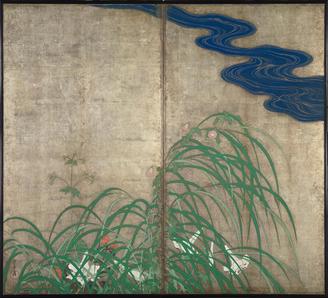
This artwork was added to the back of Ogata Kourin's "Fujin Raijin Zu Byobu" (wind god thunder god folding screen) by Tawaraya Sotatsu. The piece was commissioned by Harusada, the head of the Ishibashi family, who is the father of the 11th shogun Tokugawa Ienari. The artwork was separated into front and back parts in Showa 49 (1974), and they are now different folding screens. The moonlit ground shines with vibrant colors of summer and autumn grasses. On the right-hand screen, lotuses and other summer flowers are depicted with their leaf tips touching the ground. The background shows rainwater flowing out from the accumulated water on the ground. The summer heat is expressed without depicting raindrops. On the left-hand screen, autumn grasses such as kuzu, wisteria, suski, and wild grapes are depicted being blown by the wind from right to left in large sizes. The leaves of flying grapes and the colors of leaves turning back reveal the strength of the wind. The summer grass scene was originally the reverse of Ogata Kourin's "Raijin Fujin Zu Byobu," and the autumn grass scene was the reverse of "Fujin Raijin Zu Byobu." In other words, the summer grass was created by the rain god, and the autumn grass was created by the wind god.
この作品は、酒井抱一が尾形光琳(おがたこうりん)の「風神雷神図屏風」の裏にあとから描き加えたものです。第11代将軍徳川家斉(とくがわいえなり)の父で、一橋家の当主、治済(はるさだ)から制作を依頼された作品でした。作品保存のため、昭和49年(1974年)に表と裏に分けられ、現在はそれぞれ別の屏風になっています。 月の光を思わせる銀色の地に、夏から秋の草花が爽やかな色彩であらわされています。向かって右の屏風には、百合や昼顔などの夏草が、うなだれたように葉先を地面に向けています。背景には地面にたまった雨水が流れ出しています。雨粒を描くことなく、夏の強い夕立を表現しています。 左側の屏風には、葛(くず)や藤袴、ススキや野葡萄といった秋の草花が右から左へと大きく風に吹かれています。宙に舞う野葡萄や、裏返った葉の色に、風の強さがしめされています。 夏草図は、もともとは光琳の雷神図の裏に、秋草図は、風神図の裏にありました。つまり、この夏草は雷神がもたらした雨に打たれており、秋草は風神が巻き起こした風に吹かれているという関係にあったのです。 他にも光琳の「風神雷神図屏風」と抱一の「夏秋草図屏風」には、金と銀、天上の世界と地上の世界といった対比が見られ、光琳に憧れた抱一が、さまざまに光琳の作品に応えようとしたことがうかがえます。
View the original at Japan Search →A statute built to coax privately held work onto public walls. An owner registers a piece with the Commissioner for Cultural Affairs, then contracts with a museum to display it. Article 2 defines a work of art broadly, as paintings, sculpture, crafts and other tangible cultural products that are movable, which is the legal way of saying anything you could carry out of the house.
The cool part. The terms are the interesting part. Article 2 requires the public display contract to run for five years or more, and to contain a clause stating that the parties may not give notice of cancellation. You cannot lend a masterpiece for the tax treatment and then reclaim it when the market turns. Japan concluded the barrier to seeing art was never storage. It was ownership, and the fix was a contract you cannot walk out of.
Verify at e-Gov 法令検索 →Use it Take the ratio, not the picture. It sets a page better than a grid does.
Description source: museum curator text, translated — not generated