Quiet reading✦No ads, ever

✦Corporate brand & media services✦Made in Virginia Beach since 1997✦

Huang Goodman · Art Forgotten

Art Forgotten

Art from public museum collections. A mismatched real Japanese law, and some other factoids.

Every object, image and description comes from the museum's own catalogue record, and every object links to its original. Japanese records are machine-translated into English; the museum's Japanese is kept beside the translation because it is the authoritative form. Each law carries its official number and links to e-Gov 法令検索, the Japanese government's statute database.

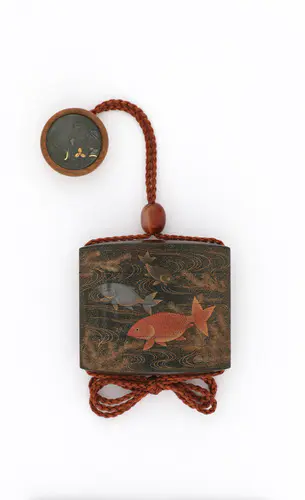
藻金魚蒔絵印籠 銘 巨柳作
{藻金魚蒔絵印籠 銘 巨柳作 · 古満巨柳 · 江戸時代中期-後期(18-19世紀) / Mid-Late Edo Period (18-19th c.) · Japan Search · 国立国会図書館}
Lotus Goldfish Plate Painting Casket Inscription: Gogyo (Giant Willow) made it. · Ancient Man Gigantic Paulownia This catalogue introduces an art piece titled "Ancient Man Gigantic Paulownia." The artwork, "Ancient Man Gigantic Paulownia," is a significant expression of the artist's creativity. It is a grand representation of the Paulownia tree, a symbol of ancient Japan. The artist meticulously crafted every detail, capturing the tree's majesty and power. The Paulownia tree, with its large leaves and imposing stature, is depicted in an extraordinary scale. Its intricate bark texture and the delicate veins on its leaves are rendered with remarkable precision. The artwork invites the viewer to contemplate the beauty and resilience of nature. The "Ancient Man Gigantic Paulownia" is a testament to the artist's dedication and mastery of their craft. Through this work, the viewer is transported to a time when the Paulownia tree held great cultural significance in Japan. The artwork serves as a reminder of the deep connection between the Japanese people and their natural environment. The "Ancient Man Gigantic Paulownia" is a must-see for anyone interested in Japanese art and culture.

A three-part cylindrical box with a black lacquer finish. Inside, there is a painting depicting carp swimming among the greenery. The interior is made of gold leaf. The bottom right corner bears an inscription.

常形3段の印籠で、黒蝋色塗金平目地に研出蒔絵で藻に金魚を表す。段内部は金梨子地で、底部右下に作銘。

View the original at Japan Search →
The law
博物館法
Museum Act
昭和二十六年法律第二百八十五号 · Act No. 285 of 1951

Article 2 defines a museum as an institution that collects, keeps and displays materials on history, art, folklore, industry and natural science for public use, carries out research on them, and which has been registered under Chapter 2 of this Act. The registration is not decorative. In law, an unregistered collection open to the public is not a museum.

The cool part. The definition of keeping is given as including raising. That single parenthesis is why a zoo, an aquarium and a botanical garden sit inside museum law in Japan: the collection is allowed to be alive. Article 1 also grounds the statute in the Social Education Act and the Basic Act on Culture and the Arts, which places museums in education first and culture second.

Verify at e-Gov 法令検索 →

Use it Two-colour foil on uncoated stock gets you most of this at production cost.

Description source: museum curator text, translated — not generated