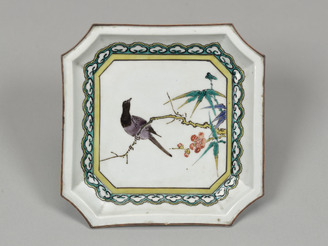
In the Meiji period when Autumn Moon flourished, there was a great popularity of fine paintings with red and gold backgrounds in the Kyoto style of pottery. He, however, aimed for the revival of old Kyoto, and handled a large number of works in the style. This piece is a typical example of the old Kyoto style.
吟秋が活躍した明治時代には、九谷焼では赤と金を基調とする細密な上絵付の「赤絵細描」が大流行していたが、彼は十七世紀の古九谷復興を志し、古九谷風の作品も数多く手がけた。この作品は、典型的な古九谷風の作例。
View the original at Japan Search →A craft cannot call itself traditional by taste or reputation. Article 2 sets five conditions, all of which must hold: it is used mainly in daily life, the main part of its making is by hand, it is made by traditional techniques, it is made chiefly from materials traditionally used, and a not-small number of people in a defined area still make it. The designation names the techniques, the materials and the region.
The cool part. Two conditions do quiet work. The first is daily use, so a technique kept alive only for display does not qualify. The fifth is the number of makers: the law will not protect a single surviving genius, because one person is a biography and not an industry. And because the region is written into the designation, the craft is legally attached to a place and cannot move.
Verify at e-Gov 法令検索 →Use it Take the ratio, not the picture. It sets a page better than a grid does.
Description source: museum curator text, translated — not generated