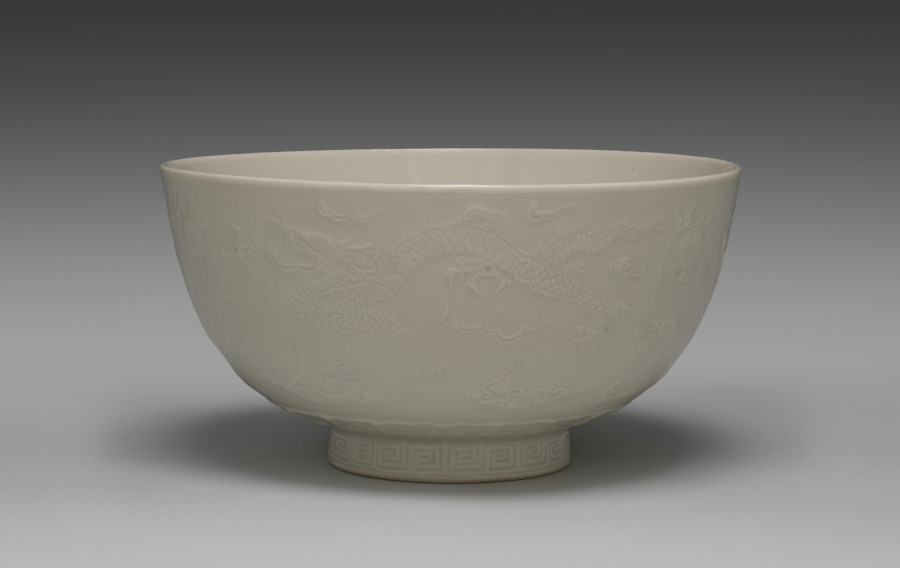
The decoration of this large bowl, described as a donburi on one side of its box, is executed entirely in molded and carved relief under a creamy, pink-tinged translucent glaze. The main motif is a pair of four-clawed dragons pursuing flaming jewels. As is standard for this design, the beasts are surrounded by wisps of cloud, and a foliate pattern runs around the bottom of the basin. A geometric pattern circles the exterior of the footring. The white-on-white design makes the bowl subtle and elegant.
View the original at Cleveland Museum of Art →A craft cannot call itself traditional by taste or reputation. Article 2 sets five conditions, all of which must hold: it is used mainly in daily life, the main part of its making is by hand, it is made by traditional techniques, it is made chiefly from materials traditionally used, and a not-small number of people in a defined area still make it. The designation names the techniques, the materials and the region.
The cool part. Two conditions do quiet work. The first is daily use, so a technique kept alive only for display does not qualify. The fifth is the number of makers: the law will not protect a single surviving genius, because one person is a biography and not an industry. And because the region is written into the designation, the craft is legally attached to a place and cannot move.
Verify at e-Gov 法令検索 →Use it Take the ratio, not the picture. It sets a page better than a grid does.
Description source: museum curator text — not generated