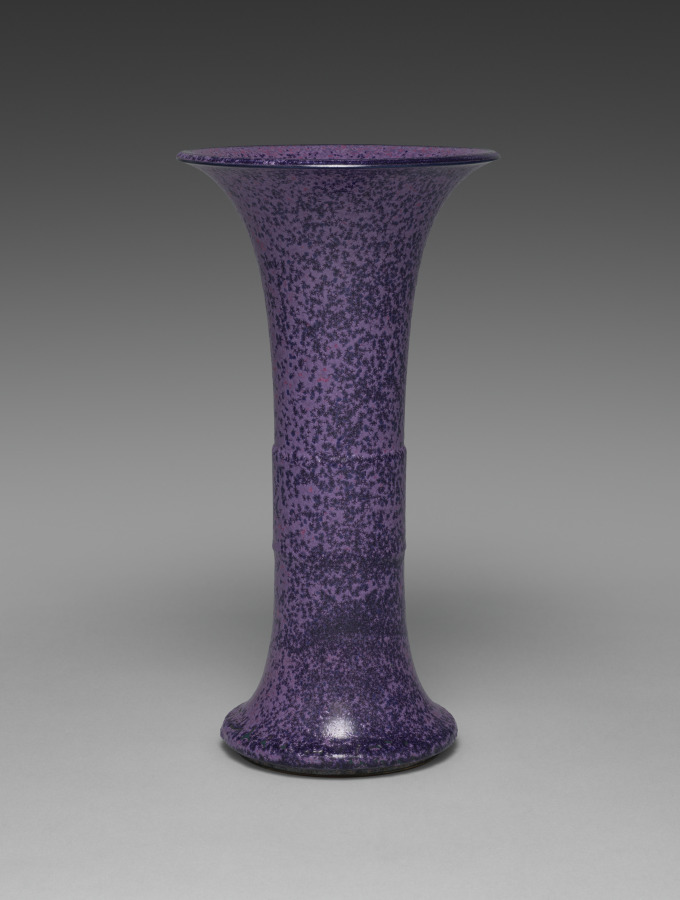
Yohei IV’s interest in bold, colorful designs is on full display in this purple gu-shaped vase. He not only exhibits his penchant for bold colors but also shows off a complex surface that suggests the patina on an ancient bronze. The body of the vase is a dark, greenish blue over which there is a thick application of color. While the predominant overlaid color is lavender purple, salmon pink and cornflower blue appear in places along with myriad nearly black forms, perhaps floating dandelion seeds or tiny flowers, scattered over the surface.
View the original at Cleveland Museum of Art →Japan implementing the 1970 UNESCO Convention. When a foreign state reports that cultural property has been stolen from an institution, the Ministry of Foreign Affairs notifies the education ministry, which designates the object as specified foreign cultural property, after consulting the trade ministry. Importing a designated object then requires approval under the foreign exchange and trade law.
The cool part. Article 6 quietly rewrites private law. Under the Civil Code a good-faith purchaser is normally secure against a recovery claim after two years. For designated stolen foreign cultural property, the victim may demand recovery from two years after the theft until ten years have passed. Buying in good faith does not settle the question for a decade, which is roughly how long it takes a stolen object to surface on a legitimate market.
Verify at e-Gov 法令検索 →Use it Palette for a single-colour run: one ink, heavy stock, nothing else on the sheet.
Description source: museum curator text — not generated