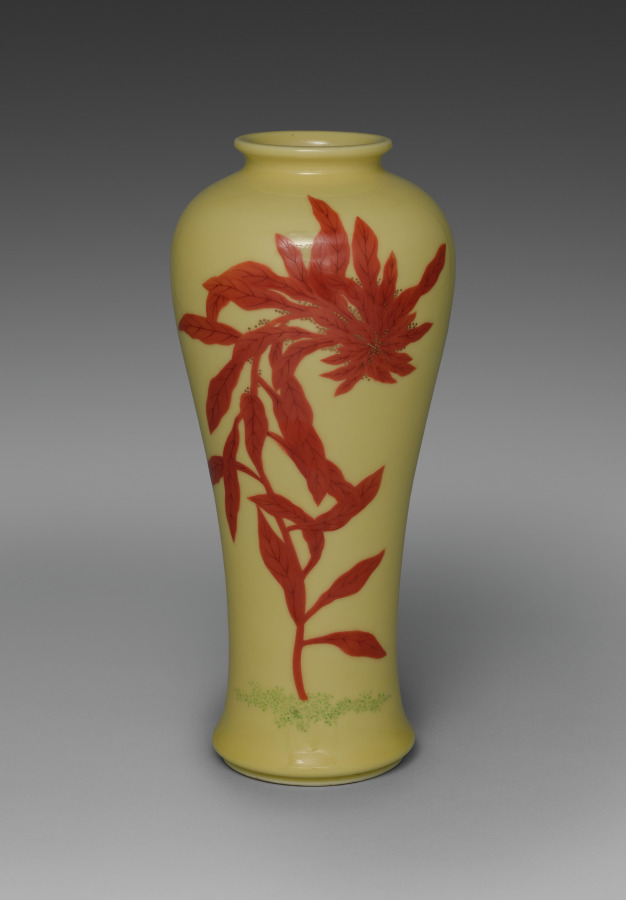
Yohei IV’s interest in bold, colorful designs is on full display in this vase shaped like a “prunus vase,” or meiping (Japanese meipin). It has two colors of amaranthus on a yellow ground. It follows a design appearing on a sleeve-shaped vase by Yohei III. Yohei IV uses bright spring-green dots of overglaze enamel to suggest a ground plane in his yellow environment; he also uses red and magenta accented with wild gold cascades of dots for two plants he places on opposite sides of the vase, one much larger than the other. In Yohei III’s version, the body of the vessel is white, and the foliage of one plant is red with carefully painted veins in gold, while another plant strategically positioned behind it has a deep rust color, again carefully detailed in gold. In a sense, Yohei IV has deconstructed his father’s logical, balanced design and re-presented it as an emotive, lightheartedly chaotic one that sates the appetite for instant gratification, much as his father’s creation rewards the pursuit of elegance.
View the original at Cleveland Museum of Art →Article 1 states the aim as a beautiful and dignified national land, and it covers not only cities but farming, mountain and fishing villages. Inside a landscape planning area, Article 16 requires advance notification of new building, extension, rebuilding, relocation, and any repair or alteration that changes the exterior. Landscape Districts go further and impose direct restrictions on the form and design of buildings.
The cool part. Read Article 16 to the end of the sentence. A change of colour is listed alongside new construction as an act you must notify. Repainting your building is, in law, the same category of event as putting up a new one. This is the machinery behind the muted shopfronts of Kyoto. The brown coffee-shop sign is not a marketing choice, it is compliance.
Verify at e-Gov 法令検索 →Use it Take the ratio, not the picture. It sets a page better than a grid does.
Description source: museum curator text — not generated