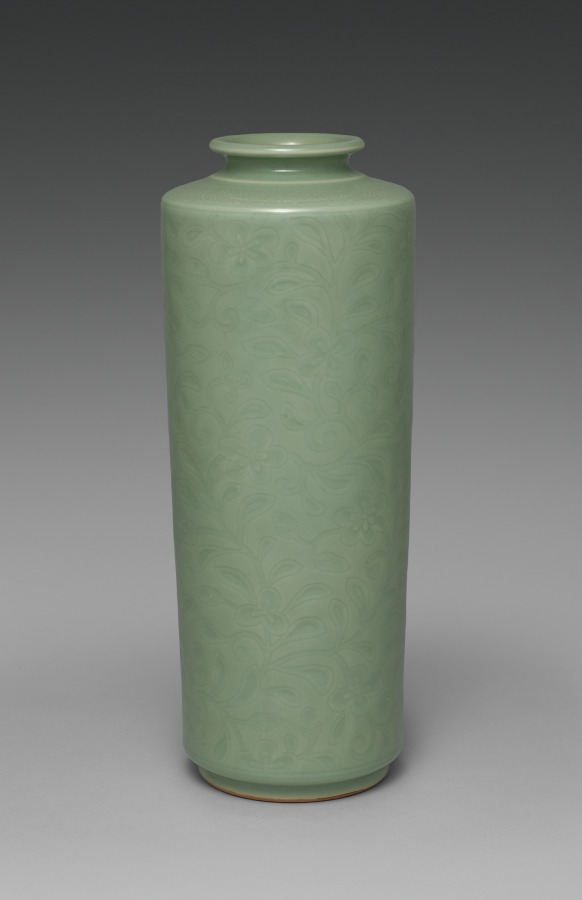
Porcelain with molded and carved design and green glaze · Japan, Taishō period (1912–26) or Shōwa period (1926–89) · height: 31.5 cm (12 3/8 in.); Diameter: 12 cm (4 3/4 in.) · Japanese Art
Many of the vases created by Yohei III and IV were made with reference to and in emulation of Chinese ceramics in both form and glazing. The vessel type called tongping, pronounced tōbin in Japanese, is tall and cylindrical, like the thick length of bamboo referenced in the shape of the ideograph tong 筒. Unlike the ancient gu, hu, and guan, this form did not emerge in China until the Ming dynasty, and many such vases date to the early Qing dynasty. Two green-glazed vases, CMA 2022.225 by Yohei III and this one by Yohei IV, are interpretations of this form. Yohei III’s version has slightly hunched shoulders and is somewhat wider at the top below the small neck and lip. Yohei IV’s vase is more angular. The wide rack of molded cloud encircling the Yohei III vase rises subtly from very low relief banding above and below it, accentuating the vessel’s rounded edges and complementing the form. In contrast, the allover flower vine pattern on the body and “seven treasures” pattern at the collar of the vase by Yohei IV evokes a garment’s cuffed sleeve, like the common English appellation for this type of vessel—“sleeve vase.”
View the original at Cleveland Museum of Art →Article 1 sets a purpose larger than preservation: to preserve cultural properties AND to make use of them, contributing to the cultural advancement of the people and to the progress of world culture. Article 4 turns that outward. An owner must recognise the object as a precious national asset, preserve it for the public, and make it public as far as possible. Ownership here carries a duty to show.
The cool part. "Living National Treasure" appears nowhere in the statute. Article 71 requires that when an Important Intangible Cultural Property is designated, the minister must also certify its holder or holding group. Japan does not register the pot, it registers the potter. Article 96 is the one that reaches ordinary people: if you uncover a shell mound, a dwelling site or a tumulus, you must leave it exactly as it is and notify the Commissioner for Cultural Affairs without delay, and the Commissioner can freeze the ground for up to three months.
Verify at e-Gov 法令検索 →Use it The border is the idea. Use it as an edge treatment and leave the centre empty.
Description source: museum curator text, translated — not generated