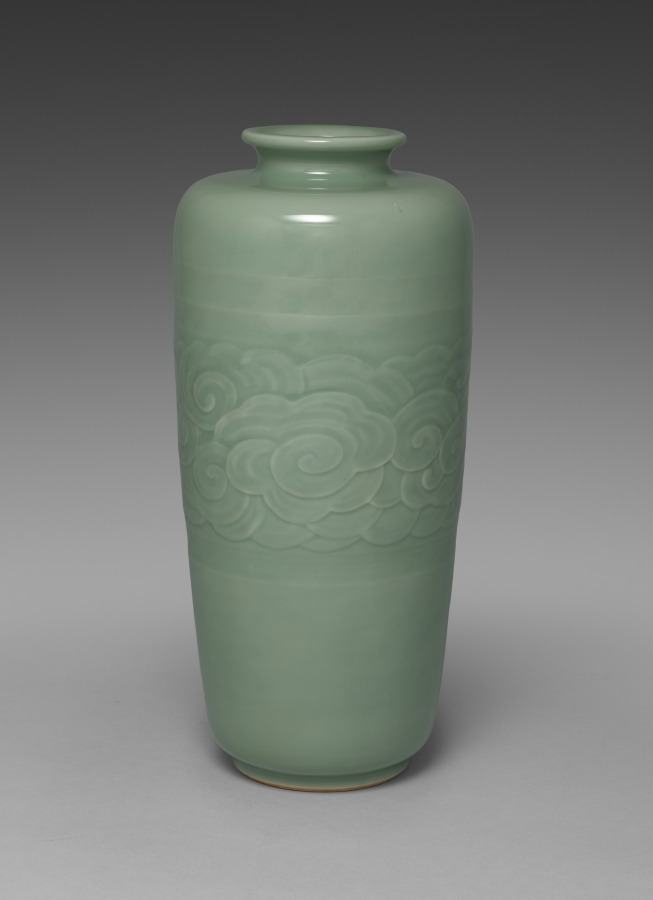
Porcelain with molded and carved design and green glaze · Japan, Meiji period (1868–1912) · height: 26.7 cm (10 1/2 in.); Diameter: 11.4 cm (4 1/2 in.); height with stand: 29.8 cm (11 3/4 in.) · Japanese Art
Many of the vases created by Yohei III and IV were made with reference to and in emulation of Chinese ceramics in both form and glazing. The vessel type called tongping, pronounced tōbin in Japanese, is tall and cylindrical, like the thick length of bamboo referenced in the shape of the ideograph tong 筒. Unlike the ancient gu, hu, and guan, this form did not emerge in China until the Ming dynasty, and many such vases date to the early Qing dynasty. Two green-glazed vases, this one by Yohei III and the other by Yohei IV CMA 2022.228, are interpretations of this form. Yohei III’s version has slightly hunched shoulders and is somewhat wider at the top below the small neck and lip. Yohei IV’s vase is more angular. The wide rack of molded cloud encircling the Yohei III vase rises subtly from very low relief banding above and below it, accentuating the vessel’s rounded edges and complementing the form. In contrast, the allover flower vine pattern on the body and “seven treasures” pattern at the collar of the vase by Yohei IV evokes a garment’s cuffed sleeve, like the common English appellation for this type of vessel—“sleeve vase.”
View the original at Cleveland Museum of Art →Article 1 states the purpose plainly: prevent trade in stolen goods, find them quickly, and speed the recovery of victims. Article 2 then defines a used article to include, in the same breath, art objects held for appreciation. Dealing in them requires a licence.
The cool part. Article 16 requires a dealer to record every transaction: the date, the item and quantity, its distinguishing features, and the address, name, occupation and age of the other party. Article 15 requires that a dealer who suspects an item is stolen report it to a police officer immediately. So the antique trade runs on a register the police may read, and a painting becomes a second-hand article the moment it has been used once.
Verify at e-Gov 法令検索 →Use it Two-colour foil on uncoated stock gets you most of this at production cost.
Description source: museum curator text, translated — not generated