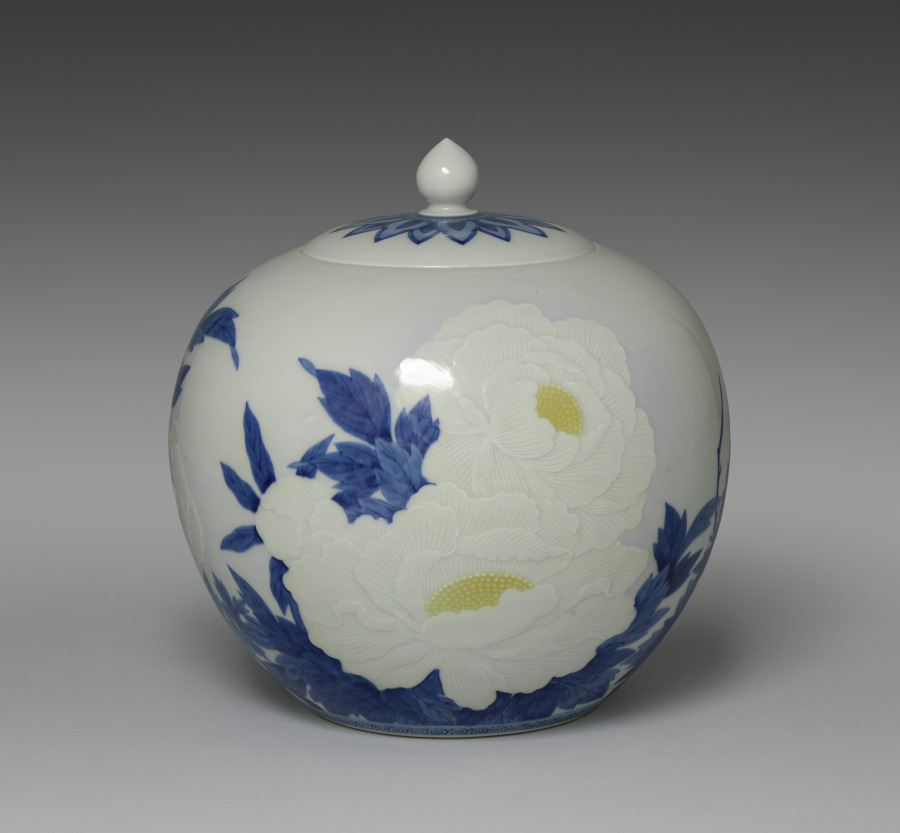
The petals of the large, white peonies on this jar were made by applying molded clay to the body and incising the clay with lines for definition. The flowers’ centers were then painted with yellow, along with the leaves in cobalt blue line and wash. A subtle blue gradation was also added all around the flowers using a masking method. The lid, with its treasured jewel-shaped finial, was also decorated with foliate motifs in underglaze cobalt blue. Finally, a transparent glaze was applied over the entire body of both the jar and lid. It is a special demonstration of Yohei III’s use of precision and control to create a completely balanced composition.
View the original at Cleveland Museum of Art →Japan implementing the 1970 UNESCO Convention. When a foreign state reports that cultural property has been stolen from an institution, the Ministry of Foreign Affairs notifies the education ministry, which designates the object as specified foreign cultural property, after consulting the trade ministry. Importing a designated object then requires approval under the foreign exchange and trade law.
The cool part. Article 6 quietly rewrites private law. Under the Civil Code a good-faith purchaser is normally secure against a recovery claim after two years. For designated stolen foreign cultural property, the victim may demand recovery from two years after the theft until ten years have passed. Buying in good faith does not settle the question for a decade, which is roughly how long it takes a stolen object to surface on a legitimate market.
Verify at e-Gov 法令検索 →Use it A motif small enough to blind-deboss, which is where restraint actually shows.
Description source: museum curator text — not generated