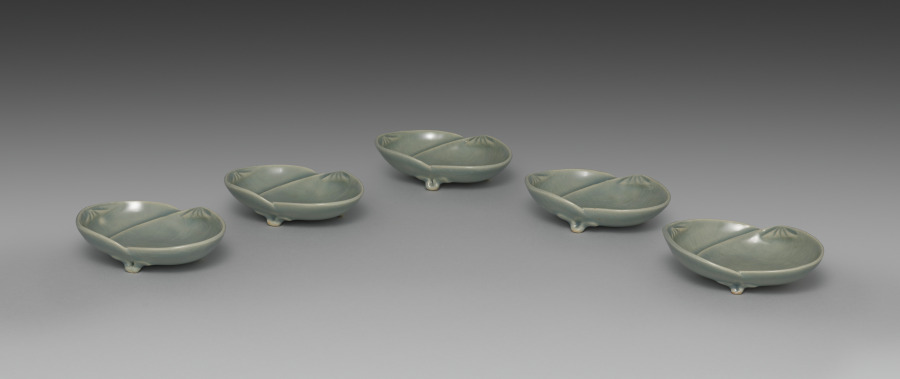
Yohei III’s main output for his sophisticated clientele was in the form of tea sets and dining sets. He created a range of dishes in green glazes. He often produced in pairs, sets of five, or sets of ten. The set of five dishes with a more complex form is described as having a “water-colored glaze” (mizuiroyū). These are shaped like clam half shells, a reference to a game in which shell halves painted with narrative scenes or a variety of motifs must be matched back together by the players. The dishes have molded details to articulate the shell forms, and the crackling across each shell adds another dimension to the surface. Each dish is set on three small feet, formed by a pinched piece of clay and attached to an unglazed area on the underside of the dish. Curiously, while four of the dishes are stamped with the artist’s mark, one has instead a signature carved into the base.
View the original at Cleveland Museum of Art →A weapons statute that contains the most important art registry in the country. Article 2 defines a sword by measurement: a blade of fifteen centimetres or more for a sword, spear or naginata, five and a half for a dagger. Article 14 then carves out an exception. The prefectural board of education registers old firearms of value as art or antiques, and swords of value as art, on the basis of an appraisal by registration examiners appointed for their scholarly knowledge.
The cool part. A Japanese sword is lawful to own because it has been certified as art. Not because it was disarmed, not because it was licensed as a weapon. The judgement is made by the board of education, and Article 14 then requires the board to notify the prefectural public safety commission of what it has decided. The culture side rules, and the police are informed afterwards. Fail the appraisal and the same object becomes contraband.
Verify at e-Gov 法令検索 →Use it Take the ratio, not the picture. It sets a page better than a grid does.
Description source: museum curator text — not generated