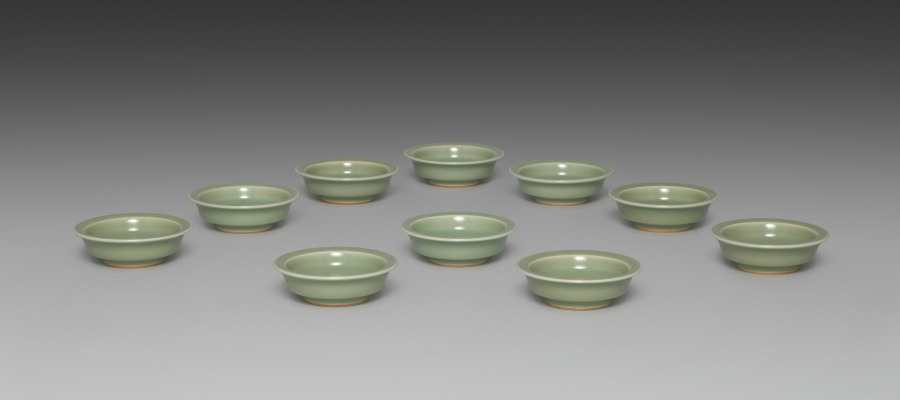
Yohei III’s main output for his sophisticated clientele was in the form of tea sets and dining sets. He created a range of dishes in green glazes. He often produced in pairs, sets of five, or sets of ten. For this set of ten small dishes in a simple, round form that emphasizes the glaze above all, the box lid designates the piece as seiji, or green-glazed porcelain, using a general term for the extensive palette of green glazes often called celadon in English. The box lid further identifies the dishes themselves as tōchō, literally “bean-sized saucers,” a size that makes them suitable for dipping sauces.
View the original at Cleveland Museum of Art →A weapons statute that contains the most important art registry in the country. Article 2 defines a sword by measurement: a blade of fifteen centimetres or more for a sword, spear or naginata, five and a half for a dagger. Article 14 then carves out an exception. The prefectural board of education registers old firearms of value as art or antiques, and swords of value as art, on the basis of an appraisal by registration examiners appointed for their scholarly knowledge.
The cool part. A Japanese sword is lawful to own because it has been certified as art. Not because it was disarmed, not because it was licensed as a weapon. The judgement is made by the board of education, and Article 14 then requires the board to notify the prefectural public safety commission of what it has decided. The culture side rules, and the police are informed afterwards. Fail the appraisal and the same object becomes contraband.
Verify at e-Gov 法令検索 →Use it Two-colour foil on uncoated stock gets you most of this at production cost.
Description source: museum curator text — not generated