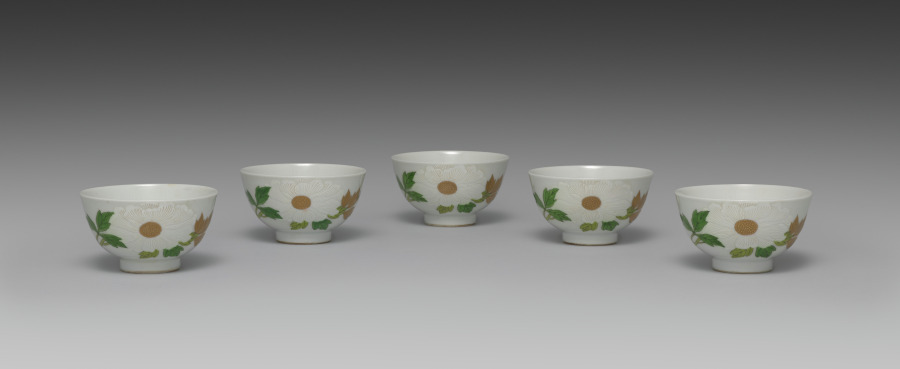
Overglaze color enamels are generally called iro-e (literally “color picture”) in the terminology customarily used for porcelain decoration of the Edo period. This set of teabowls is a fine example of Yohei III’s skilled use of the technique, which is identified on this set’s box lid with the alternate phrasing “porcelain with color painting” (jisaiga). Distinct from the way overglaze colors were used in Kakiemon ware from Arita, his designs and applications show a consciousness of porcelain decoration of the Qing dynasty. Here, he combines Chinese models with a sensibility taken from Kyoto ware precedents, including painting with powdered gold (kinrande). The colors used in the bowls are as follows: blue, black, gold, white, light green, green, and pink. The blue appears only inside the footring, as a double band of underglaze color. The black iron, used for stems and leaf veins, is painted over the glaze. The gold, also painted over the glaze, is used for leaves and the centers of flowers, for solid, glossy lines defining detail, or as a semimatte ground. The white of the peony flower is built up to a low relief over the glaze. Yohei has incised lines of varying widths into the pigment, carving away to the bowl’s surface, to differentiate individual petals and their rippled shapes. The light and dark greens, as well as the pink, are painted over the glaze.
View the original at Cleveland Museum of Art →A craft cannot call itself traditional by taste or reputation. Article 2 sets five conditions, all of which must hold: it is used mainly in daily life, the main part of its making is by hand, it is made by traditional techniques, it is made chiefly from materials traditionally used, and a not-small number of people in a defined area still make it. The designation names the techniques, the materials and the region.
The cool part. Two conditions do quiet work. The first is daily use, so a technique kept alive only for display does not qualify. The fifth is the number of makers: the law will not protect a single surviving genius, because one person is a biography and not an industry. And because the region is written into the designation, the craft is legally attached to a place and cannot move.
Verify at e-Gov 法令検索 →Use it The border is the idea. Use it as an edge treatment and leave the centre empty.
Description source: museum curator text — not generated