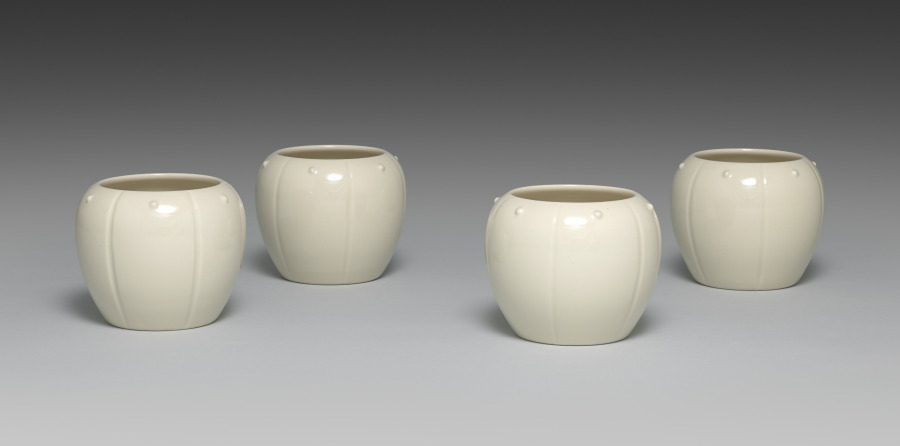
The box lid for these six-lobed lit charcoal and ash containers, or hiire, identifies them as kōhakuji, another of Yohei III’s translucent cream colors over ivory clay bodies. One might translate the name as “lustrous pearl[–glazed ivory] porcelain.” A hiire was filled with ash with burnt coals at the center so that embers and tobacco ash could be discarded safely during a gathering. Each of the lobes on the containers has a round protrusion set below the rim. The studlike pattern is called ruiza. The term is also used to describe the pattern that rings the shoulder of some flower vases or metal kettles used in chanoyu.
View the original at Cleveland Museum of Art →Unusually for a Japanese statute it opens with a preamble, which states that finding joy in creating culture and living among it is an unchanging wish of people, and that culture contributes to world peace. Article 2 then sets the principles: the autonomy of those who make culture must be fully respected, and their creativity, standing and capacity considered.
The cool part. Article 2, paragraph 3 is the line worth reading twice. It says that creating and receiving culture is a right people are born with, and requires an environment in which citizens can appreciate, participate and create regardless of age, disability, economic situation, or the area they live in. Four barriers named in statute, one of which is your postcode. It puts the arts in the same grammatical register as infrastructure. Not a subsidy argued for each year, a standing obligation.
Verify at e-Gov 法令検索 →Use it The border is the idea. Use it as an edge treatment and leave the centre empty.
Description source: museum curator text — not generated