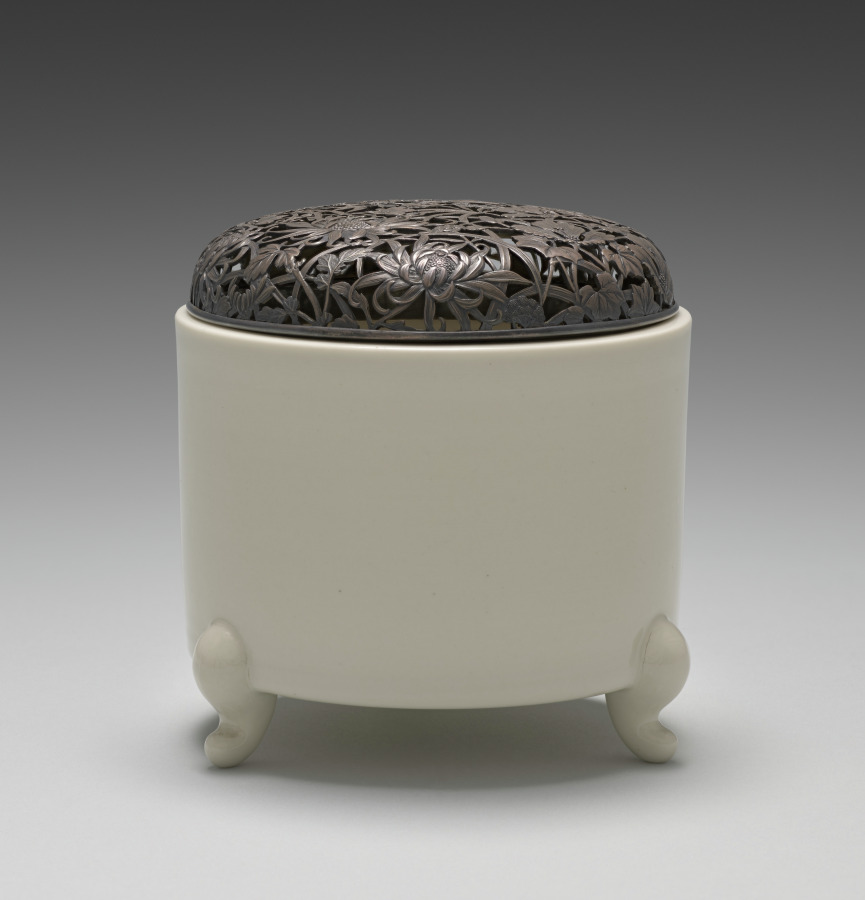
Yohei III made incense burners in a wide variety of designs and styles. The body and glaze of this one are taihakuji, or “great white porcelain,” an important early invention Yohei III devised in 1872. The burner has rounded, cabriole legs, resembling tiny table legs, attached to the exterior and the faintest decorative band around the bottom. Lids were produced outside the studio by metalwork specialists. For this incense burner, they created a floral-patterned silver lid.
View the original at Cleveland Museum of Art →A craft cannot call itself traditional by taste or reputation. Article 2 sets five conditions, all of which must hold: it is used mainly in daily life, the main part of its making is by hand, it is made by traditional techniques, it is made chiefly from materials traditionally used, and a not-small number of people in a defined area still make it. The designation names the techniques, the materials and the region.
The cool part. Two conditions do quiet work. The first is daily use, so a technique kept alive only for display does not qualify. The fifth is the number of makers: the law will not protect a single surviving genius, because one person is a biography and not an industry. And because the region is written into the designation, the craft is legally attached to a place and cannot move.
Verify at e-Gov 法令検索 →Use it The border is the idea. Use it as an edge treatment and leave the centre empty.
Description source: museum curator text — not generated