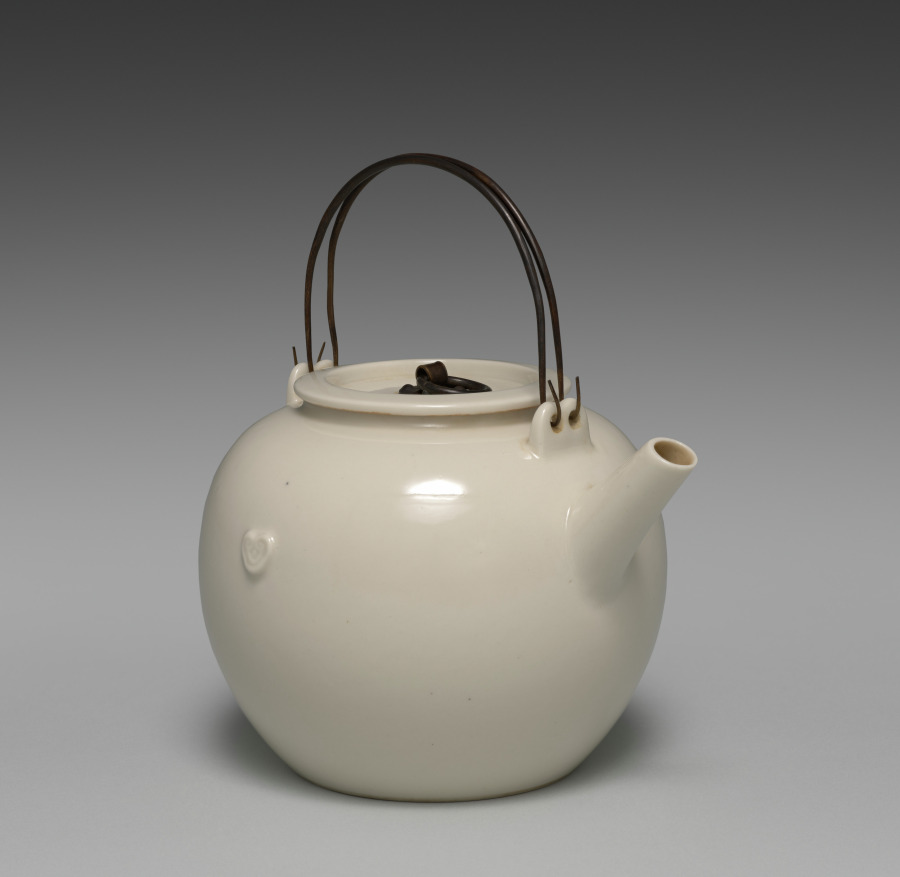
The simple, round form of this teapot is embellished with only a pair of nyoi staff-head motifs, one on each side. Two arched iron handles, parallel to each other, are hooked through holes in raised tabs at the front and back of the shoulders of the pot. The round lid is depressed so that an iron ring handle fastened with an iron clamp passing through the lid can lie flat inside the recessed area. The box is not original to the piece and has an inscription dated to 1960. The person who wrote it clearly admired Yohei III and his efforts to produce works that resembled Chinese ceramics. The inscription describes Yohei’s journey to perfecting these copies but misidentified the Chinese kiln whose wares were the basis for this particular work.
View the original at Cleveland Museum of Art →Article 2 defines a museum as an institution that collects, keeps and displays materials on history, art, folklore, industry and natural science for public use, carries out research on them, and which has been registered under Chapter 2 of this Act. The registration is not decorative. In law, an unregistered collection open to the public is not a museum.
The cool part. The definition of keeping is given as including raising. That single parenthesis is why a zoo, an aquarium and a botanical garden sit inside museum law in Japan: the collection is allowed to be alive. Article 1 also grounds the statute in the Social Education Act and the Basic Act on Culture and the Arts, which places museums in education first and culture second.
Verify at e-Gov 法令検索 →Use it Two-colour foil on uncoated stock gets you most of this at production cost.
Description source: museum curator text — not generated