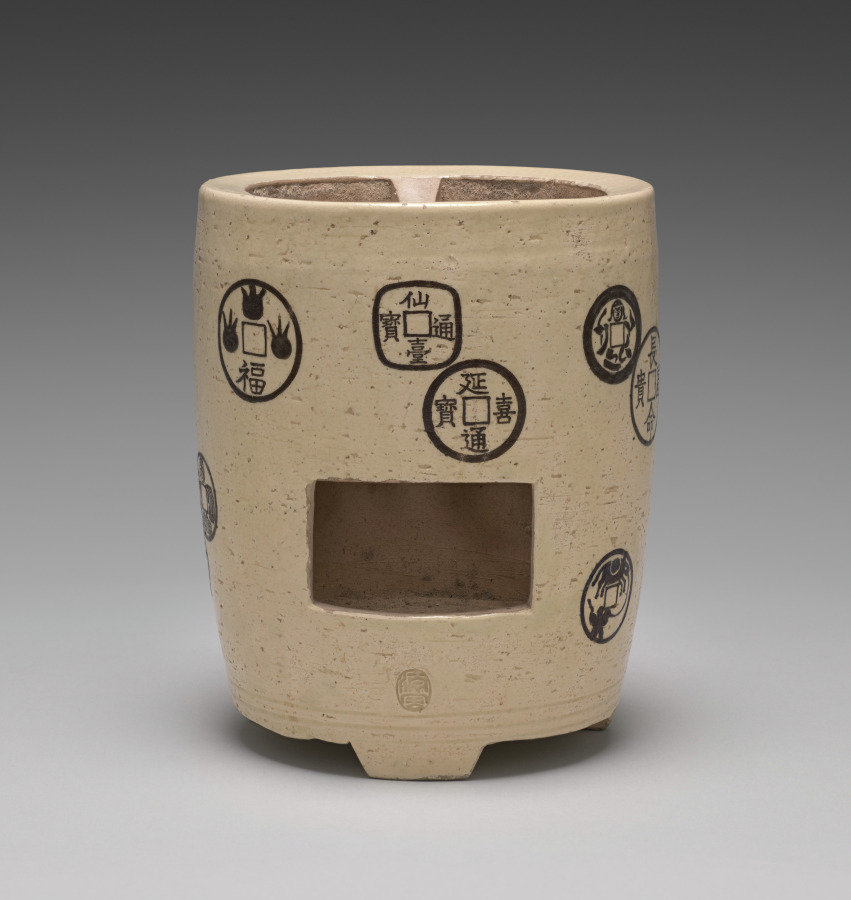
Tall pottery braziers called ryōro are often used to heat the water for the tea served at sencha gatherings. This one sits on three sturdy legs, one of which bears the artist’s seal on its face. A horizontal rectilinear opening above this leg allows air to circulate into the lower part of the brazier. The top part is outfitted with three prongs onto which the kettle can be lowered; below them is a basin, perforated with circular holes, that holds the charcoal fuel. The brazier is decorated under the crackled transparent glaze with a design of old coins in iron oxide. The motif is cleverly chosen, for most older coins are round with a central hole, often square, which echoes the cylindrical form of the brazier with its rectilinear “wind gate,” or fūmon.
View the original at Cleveland Museum of Art →Article 1 states the purpose plainly: prevent trade in stolen goods, find them quickly, and speed the recovery of victims. Article 2 then defines a used article to include, in the same breath, art objects held for appreciation. Dealing in them requires a licence.
The cool part. Article 16 requires a dealer to record every transaction: the date, the item and quantity, its distinguishing features, and the address, name, occupation and age of the other party. Article 15 requires that a dealer who suspects an item is stolen report it to a police officer immediately. So the antique trade runs on a register the police may read, and a painting becomes a second-hand article the moment it has been used once.
Verify at e-Gov 法令検索 →Use it Two-colour foil on uncoated stock gets you most of this at production cost.
Description source: museum curator text — not generated