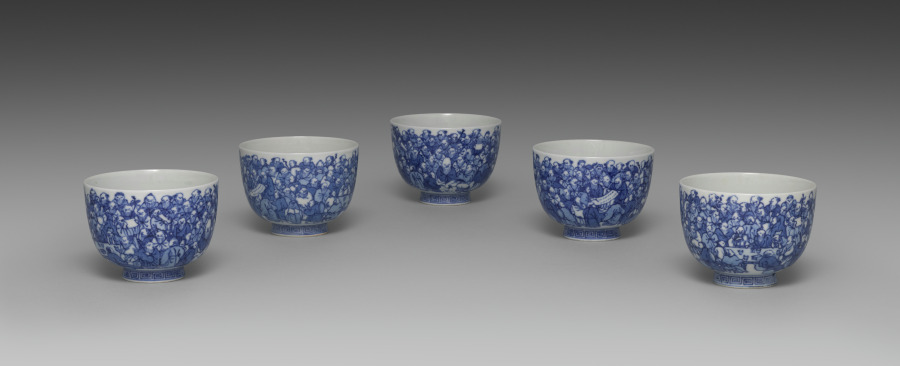
Each of these five teacups has a painting of identical design in underglaze blue, but as the tiny figures are drawn entirely by hand, each cup has its own personality. The theme of the sencha cups is an assembly of sages or immortals, literally “a hundred venerable [people]” (hyakurō). The myriad figures crowd the scene in groups. The god of longevity, with his tall forehead, sits with his cranes, having flown in from Mt. Penglai on the Isle of the Immortals. Seven long-bearded sages sit around a stone table, chatting and drinking; one is seated on an enormous gourd. Of course, there is a stack of books on the table, and elsewhere, scrolls are being written upon or read—in one case held very close by a sage who is wearing glasses. The design was enormously popular in ceramics made for those engaged in literati culture.
View the original at Cleveland Museum of Art →Article 1 gives three grounds for regulating a sign: forming good landscape, maintaining scenic character, and preventing danger to the public. Article 3 then lets a prefecture prohibit outdoor advertising outright, by ordinance, in named categories of place.
The cool part. Read the list in Article 3 and it stops being an advertising law. The places where signage can be banned include landscape districts, scenic districts, preservation districts for groups of traditional buildings, the surroundings of designated Important Cultural Properties, and historic sites, places of scenic beauty and natural monuments. The statute protects the view by removing the sentences written across it.
Verify at e-Gov 法令検索 →Use it Palette for a single-colour run: one ink, heavy stock, nothing else on the sheet.
Description source: museum curator text — not generated