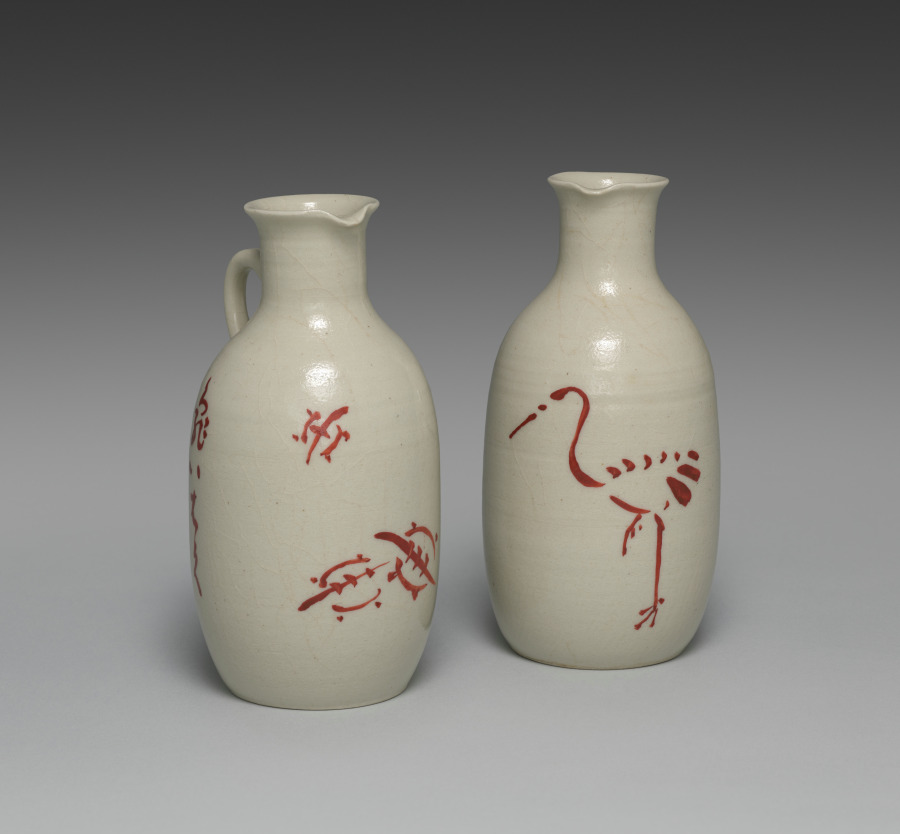
One flask in this pair displays three turtles, including a young one with its parents, while the other depicts a crane with one leg lifted. Turtles and cranes are widely symbolic of long life in East Asia, with the turtle believed to live for ten thousand years and the crane for a thousand. Each flask contains a poem on the back, one in Chinese and the other in Japanese. The Japanese poem on the turtle flask says, "kame iwaku kamiyo wa, ore no wakaki toki," which consists of seventeen syllables and starts with "turtle" and ends with "when I was young." This can be translated as, "the turtle claimed the world began when I was young." The poem on the crane flask consists of two non-sequential five-character lines from a poem titled "Crane Feelings" by the renowned Tang dynasty poet Bai Juyi (772-846). One character in one of the lines has been changed. This altered poetic excerpt reads, "zheng shi qun ji qian, tong you zhe tong zhi." It could potentially be translated as, "before the flock of chickens fought for food, those traveling together shared the same aspirations.
One flask of this pair has stencil-like paintings of three turtles—a young one with its parents—while the other has a crane with a leg raised. Cranes and turtles are well-recognized symbols of longevity in East Asia, with the turtle said to live for ten thousand years and the crane for one thousand. Each flask also has a poem on the back, one in Chinese and the other in Japanese. The latter, which appears on the turtle flask, reads kame iwaku kamiyo wa, ore no wakaki toki. The seventeen-syllable poem begins with “turtle” and ends with “when I was young.” It can be translated as, “the turtle said the world of the gods began when I was young.” The poem on the crane flask is two nonconsecutive five-character lines from a poem called “Crane Feelings” by the famous Tang dynasty poet Bai Juyi (772–846). One character in one of the lines has been altered. This creative poetic sampling results in a verse reading zheng shi qun ji qian, tong you zhe tong zhi 爭食羣雞前,同遊者同志. It could perhaps be translated, “before the flock of chickens competing for food, those traveling together have the same ambitions.”
View the original at Cleveland Museum of Art →Article 1 sets a purpose larger than preservation: to preserve cultural properties AND to make use of them, contributing to the cultural advancement of the people and to the progress of world culture. Article 4 turns that outward. An owner must recognise the object as a precious national asset, preserve it for the public, and make it public as far as possible. Ownership here carries a duty to show.
The cool part. "Living National Treasure" appears nowhere in the statute. Article 71 requires that when an Important Intangible Cultural Property is designated, the minister must also certify its holder or holding group. Japan does not register the pot, it registers the potter. Article 96 is the one that reaches ordinary people: if you uncover a shell mound, a dwelling site or a tumulus, you must leave it exactly as it is and notify the Commissioner for Cultural Affairs without delay, and the Commissioner can freeze the ground for up to three months.
Verify at e-Gov 法令検索 →Use it The border is the idea. Use it as an edge treatment and leave the centre empty.
Description source: museum curator text, translated — not generated