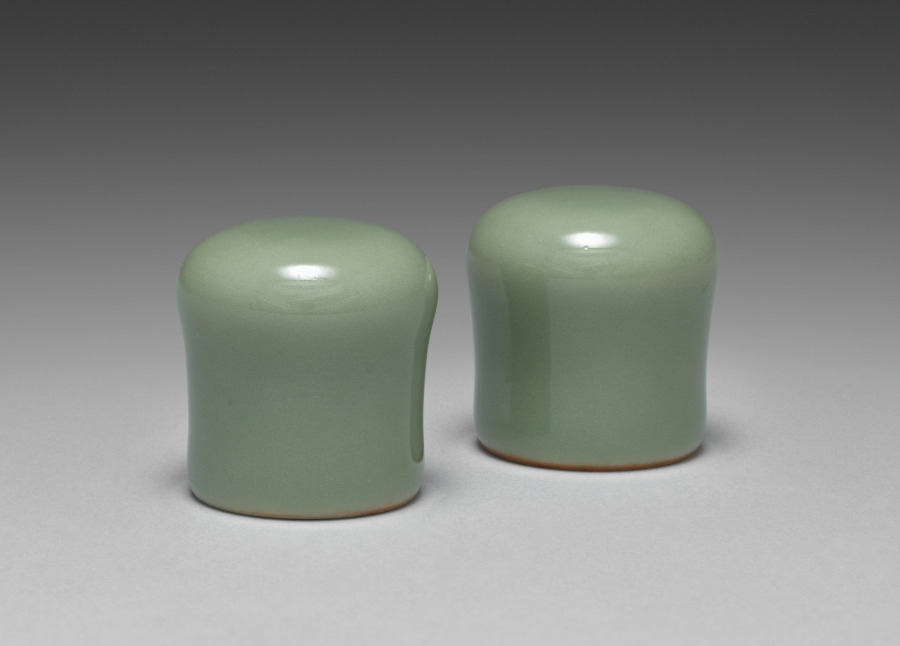
Before entering into his apprenticeship with Yohei II, Seifū Yohei III trained as a painter in Osaka. He continued to paint throughout his career as a ceramist. As part of his ceramic practice, Yohei III also made roller ends to be placed at either end of the wooden dowel around which the lower part of a hanging scroll mounting is wrapped. These served both as weights for the painting and as knobs for handling it when rolling and unrolling. The pair here is made of porcelain with a green glaze.
View the original at Cleveland Museum of Art →A weapons statute that contains the most important art registry in the country. Article 2 defines a sword by measurement: a blade of fifteen centimetres or more for a sword, spear or naginata, five and a half for a dagger. Article 14 then carves out an exception. The prefectural board of education registers old firearms of value as art or antiques, and swords of value as art, on the basis of an appraisal by registration examiners appointed for their scholarly knowledge.
The cool part. A Japanese sword is lawful to own because it has been certified as art. Not because it was disarmed, not because it was licensed as a weapon. The judgement is made by the board of education, and Article 14 then requires the board to notify the prefectural public safety commission of what it has decided. The culture side rules, and the police are informed afterwards. Fail the appraisal and the same object becomes contraband.
Verify at e-Gov 法令検索 →Use it A motif small enough to blind-deboss, which is where restraint actually shows.
Description source: museum curator text — not generated