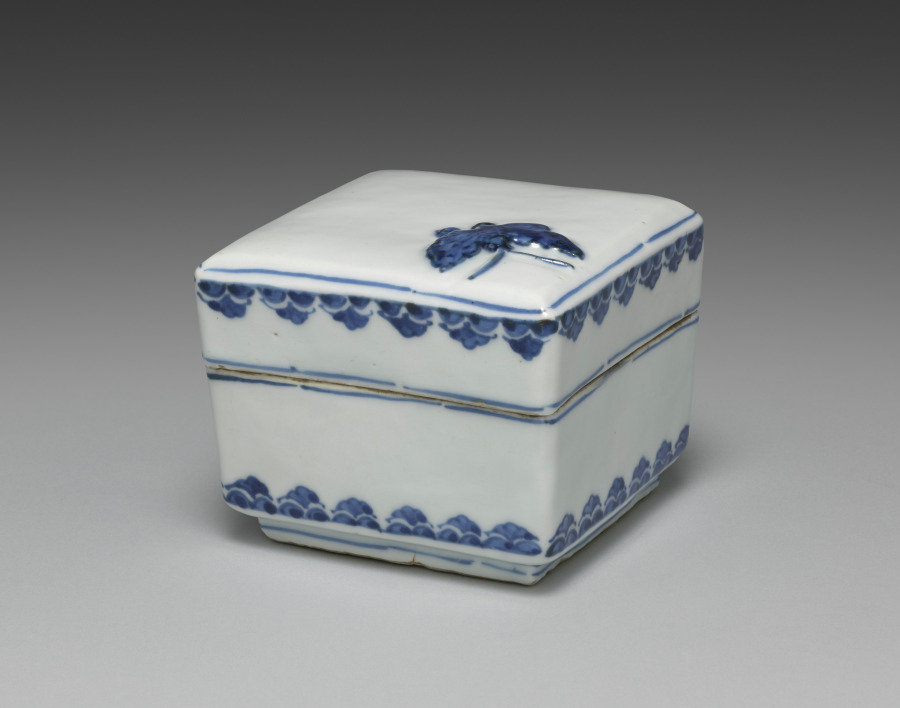
This sturdy box, with comparatively thick walls and resulting heft, is sparsely decorated with a single butterfly motif in dark underglaze blue cobalt in one corner of the lid and with repeating floral patterns along the lid and base. Single broken lines of underglaze blue define the edge of the box lid’s top where it curves to meet the sides and again where it meets the base of the box. Another blue band runs around the upper rim of the base where it meets the lip, left unglazed for a better grip of the lid when the box is closed. Yohei I’s signature on the center of the recessed base is set within a wide blue square. The porcelain box is meant to call to mind a famous story attributed to Zhuang Zhou (c. 369–286 BCE), also known as Master Zhuang, or Zhuangzi, pronounced Soji in Japanese. The second chapter of Zhuangzi, his eponymous collection of anecdotes, records the story as follows: Once, Zhuang Zhou dreamt he was a butterfly, a butterfly flitting and fluttering about, happy with himself and doing as he pleased. He didn’t know that he was Zhuang Zhou. Suddenly, he woke up and there he was, solid and unmistakable Zhuang Zhou. But he didn’t know if he was Zhuang Zhou who had dreamt he was a butterfly, or a butterfly dreaming that he was Zhuang Zhou. Between Zhuang Zhou and the butterfly there must be some distinction! This is called the Transformation of Things.
View the original at Cleveland Museum of Art →Japan implementing the 1970 UNESCO Convention. When a foreign state reports that cultural property has been stolen from an institution, the Ministry of Foreign Affairs notifies the education ministry, which designates the object as specified foreign cultural property, after consulting the trade ministry. Importing a designated object then requires approval under the foreign exchange and trade law.
The cool part. Article 6 quietly rewrites private law. Under the Civil Code a good-faith purchaser is normally secure against a recovery claim after two years. For designated stolen foreign cultural property, the victim may demand recovery from two years after the theft until ten years have passed. Buying in good faith does not settle the question for a decade, which is roughly how long it takes a stolen object to surface on a legitimate market.
Verify at e-Gov 法令検索 →Use it The border is the idea. Use it as an edge treatment and leave the centre empty.
Description source: museum curator text — not generated