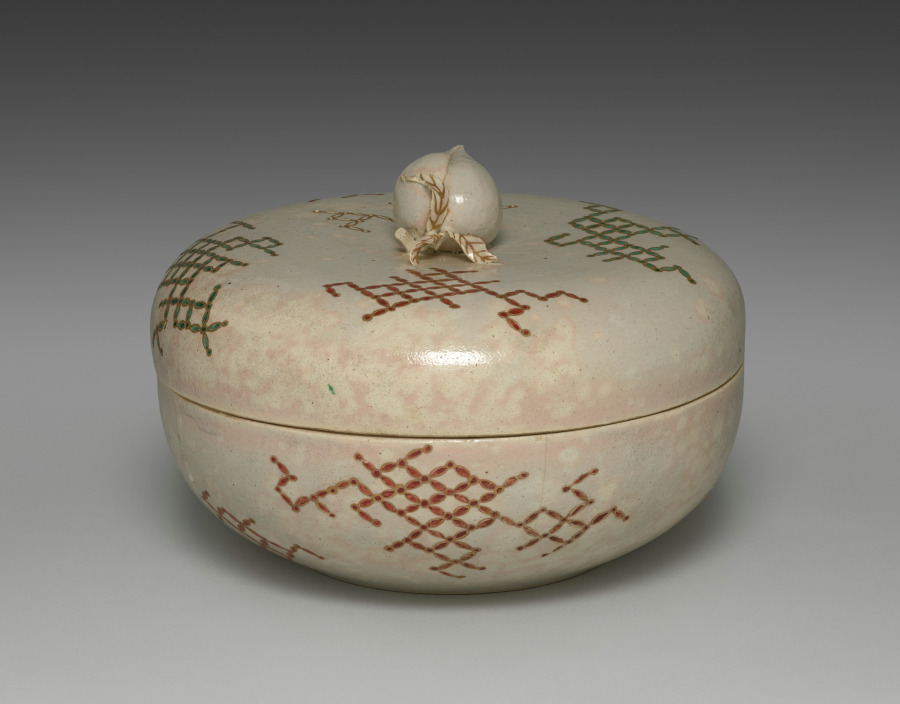
The box lid for this large covered bowl by Yohei II identifies it as in the style of Ninsei, a reference to Nonomura Ninsei. Overglaze enamels in red, green, and white sit within lattices of jewel-shaped gold forms scattered across the lid and base in a design known as the seven treasures. At the center of the lid is a knob in the shape of a peach with a stem and leaves. A prominent feature of the piece is the appearance of warm pink dots known as gohon. Here creamy at their center and with a gradation to almost red at the edges, they appear during firing due to high iron content in the clay. Pieces with this effect were made in emulation of certain ash-glazed ceramics imported from Korea. The originals were made to order for the Japanese market at a kiln in Busan. The kiln was established within the Japanese diplomatic compound in that port city by the lord of Tsushima in 1639 and continued production until 1717. In the 17th century, teabowls from Korea in a variety of styles were extremely popular among practitioners of Japanese-style tea, and they were soon copied by ceramists active on the archipelago, including in Kyoto.
View the original at Cleveland Museum of Art →A craft cannot call itself traditional by taste or reputation. Article 2 sets five conditions, all of which must hold: it is used mainly in daily life, the main part of its making is by hand, it is made by traditional techniques, it is made chiefly from materials traditionally used, and a not-small number of people in a defined area still make it. The designation names the techniques, the materials and the region.
The cool part. Two conditions do quiet work. The first is daily use, so a technique kept alive only for display does not qualify. The fifth is the number of makers: the law will not protect a single surviving genius, because one person is a biography and not an industry. And because the region is written into the designation, the craft is legally attached to a place and cannot move.
Verify at e-Gov 法令検索 →Use it Take the ratio, not the picture. It sets a page better than a grid does.
Description source: museum curator text — not generated