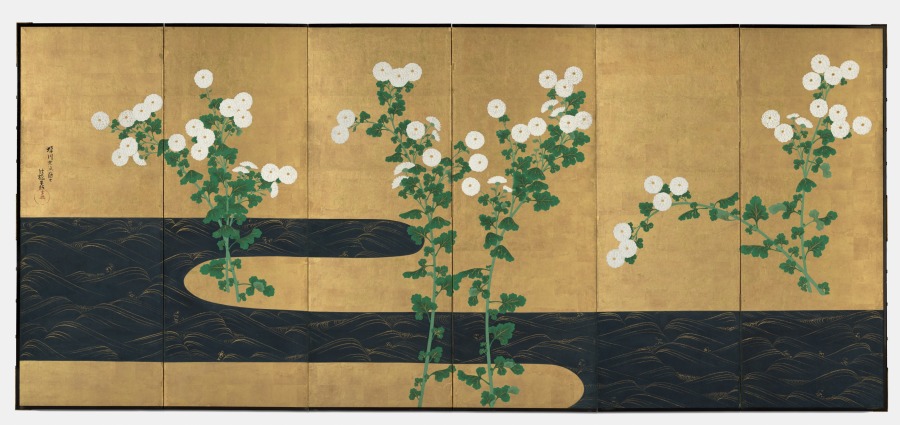
These screens recall a painting style so closely identified with Ogata Kōrin (1658–1716) that it is called Rinpa, or “Rin School,” after the ideograph “rin” in his name. The highly stylized background accentuates floral groupings that have been groomed so as to appear utterly artificial, like the synthetic arrangements available today. Kōrin's genius derived in large measure from natural phenomena painstakingly observed and then manipulated to create compositions of startling refinement and sparkling isolation. This process may have grown out of Kōrin's early immersion in the family textile business, a medium that encourages such dramatic distillations of form: the stream's gold-crested waves bring to mind traditional kimono robe designs of Kōrin's era. Works with the signature seen on this painting, including a style name, or persona suggested to Kōrin by his brother Kenzan (1663–1743), are sometimes considered to have been produced either in the last year of his life, when he was very ill, or after his death. In both scenarios, the lion’s share of the work would have been done by studio assistants, but little is truly known of his studio practice. Given the regularity of the gold waves on the stream, and the tension in the arrangement of the chrysanthemums, it is also possible that the screens were made in emulation of Kōrin's designs by a later artist.
View the original at Cleveland Museum of Art →Article 1 sets a purpose larger than preservation: to preserve cultural properties AND to make use of them, contributing to the cultural advancement of the people and to the progress of world culture. Article 4 turns that outward. An owner must recognise the object as a precious national asset, preserve it for the public, and make it public as far as possible. Ownership here carries a duty to show.
The cool part. "Living National Treasure" appears nowhere in the statute. Article 71 requires that when an Important Intangible Cultural Property is designated, the minister must also certify its holder or holding group. Japan does not register the pot, it registers the potter. Article 96 is the one that reaches ordinary people: if you uncover a shell mound, a dwelling site or a tumulus, you must leave it exactly as it is and notify the Commissioner for Cultural Affairs without delay, and the Commissioner can freeze the ground for up to three months.
Verify at e-Gov 法令検索 →Use it The border is the idea. Use it as an edge treatment and leave the centre empty.
Description source: museum curator text — not generated