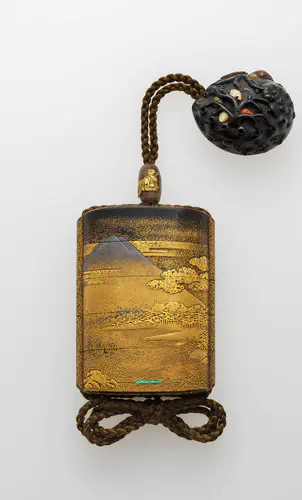
The inrō is a traditional attire originally used for storing medicine, but it was also frequently used as an ornamental dressing case without any medicine inside. The origin of the name inrō is unclear, but it is believed to be derived from the fact that inro and the inrō used as a floor decoration during the Muromachi period, which had the imprint of Chinese porcelain, share a similar shape. However, the use of inrō during the Edo period was primarily for storing medicine. There are often traces of actual medicine remaining or the interior being inscribed with the name of the medicine. Even in high-quality inrō, they were used for their medicinal function. This particular piece is a four-section inrō, painted in black lacquer with a meat-glue painting of Fuji Mountain, Mt. Sano, and Clear Water Temple. The inside is coated with gold leaf. The lid and the back of each section have labels with the names of the medicines.
印籠は元来薬入れを用途とする装身具で、後には薬を入れずに装身具として提げることも多かった。印籠の名称の由来は明らかでなく、室町時代に床飾りであった唐物の印を入れる印籠と薬を入れる薬籠の形状が似ていたためとも伝えられるが定かでない。ともかくも江戸時代の印籠の用途は薬入れであって、印を入れるものはほとんどない。実際に薬がそのまま残されたものや、内側に薬名を墨書したものもしばしばみられ、上等な蒔絵の印籠でも、薬入れとして実用に使われていたことがわかる。本作は、常形4段の印籠で、黒蝋色塗地に肉合研出蒔絵と螺鈿で富士山・三保松原・清見寺を表す。段内部は金梨子地。蓋裏と各段の裏に薬の名が書かれた貼札がある。
View the original at Japan Search →A national statute written for one city. Article 1 recites the beauty of Kyoto and its historically, culturally and artistically important position in the world, and gives two purposes: to raise international culture and serve the ideal of permanent world peace, and to contribute to the economic recovery of Japan. It was passed five years after the war ended.
The cool part. Article 3 lets Kyoto designate culture tourism preservation districts and, by ordinance, prohibit building, rebuilding, removal, changes to the shape of the land and the cutting of bamboo, trees and stone, with compensation for ordinary loss. Then Article 4 does something statutes almost never do. It places a duty on the mayor personally: in the spirit of local autonomy, and with the cooperation of residents, the mayor must engage in ceaseless activity to complete the city. Nara received its own Act, number 250, the day before.
Verify at e-Gov 法令検索 →Use it A motif small enough to blind-deboss, which is where restraint actually shows.
Description source: museum curator text, translated — not generated