Huang Goodman · Art Forgotten

Art Forgotten

Art from public museum collections. A mismatched real Japanese law, and some other factoids.

Every object, image and description comes from the museum's own catalogue record, and every object links to its original. Japanese records are machine-translated into English; the museum's Japanese is kept beside the translation because it is the authoritative form. Each law carries its official number and links to e-Gov 法令検索, the Japanese government's statute database.

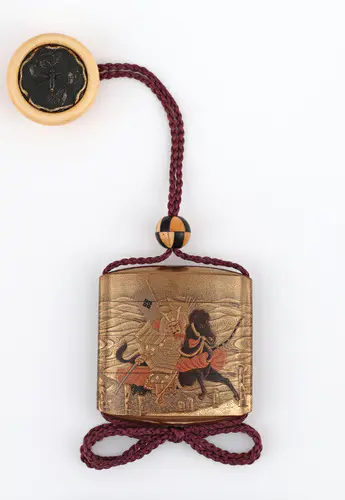
宇治川先陣争蒔絵印籠 銘 成之作
{宇治川先陣争蒔絵印籠 銘 成之作 · 今泉成之 · 大正-昭和時代(20世紀) / Taisho-Showa Period (20th c.) · Japan Search · 国立国会図書館}
Ujigawa senjin no sasuka-e inro (label) Made by: Succession of Ujigawa Item: Ujigawa's collection case for Sasuka-e (paintings on paper) · Mineo Succession" The following is an introduction to the collection of artworks that have been passed down through the Mineo Succession. First, we will introduce the main piece of this collection, which is a painting titled "Landscape with a Waterfall." This work depicts a serene and picturesque landscape with a grand waterfall in the center. The brushwork is meticulous, and the colors are rich and vibrant. Next, we will present a group of calligraphic works. These pieces showcase the elegant and refined hand of the artist, as they were created using only a brush and ink. The characters are written in a traditional style, and each piece conveys a unique sense of grace and beauty. Following the calligraphy, we will introduce a series of ink wash paintings. These works showcase the artist's skill in capturing the essence of nature through the use of bold, expressive brushstrokes and delicate washes of ink. The subjects range from landscapes and still lifes to figures and animals. Finally, we will present a selection of sculptures. These works demonstrate the artist's mastery of form and texture, as they are crafted from a variety of materials including bronze, clay, and wood. The intricate details and lifelike quality of each piece are truly awe-inspiring. Throughout this catalog, we invite you to explore the depth and richness of the Mineo Succession, as we delve into the world of art created by the skilled and talented hands of the artists who have passed down these works through the generations.

This object has a three-part shaped box with a gold inlay. Inside, there are a suspended painting and a high suspended painting depicting the Ujigawa early battle. The interior is made of gold lacquer. There is an inscription at the bottom center. A pottery painter of the Taisho and Showa periods placed their own seal on it.

常形3段の印籠で、金粉溜地に研出蒔絵と高蒔絵で宇治川先陣争を表す。段内部は金梨子地。底部中央下に作銘がある。大正・昭和期の蒔絵師が自身銘を入れたもの。

View the original at Japan Search →
The law
美術品の美術館における公開の促進に関する法律
Act on Promotion of Public Exhibition of Works of Art in Museums
平成十年法律第九十九号 · Act No. 99 of 1998

A statute built to coax privately held work onto public walls. An owner registers a piece with the Commissioner for Cultural Affairs, then contracts with a museum to display it. Article 2 defines a work of art broadly, as paintings, sculpture, crafts and other tangible cultural products that are movable, which is the legal way of saying anything you could carry out of the house.

The cool part. The terms are the interesting part. Article 2 requires the public display contract to run for five years or more, and to contain a clause stating that the parties may not give notice of cancellation. You cannot lend a masterpiece for the tax treatment and then reclaim it when the market turns. Japan concluded the barrier to seeing art was never storage. It was ownership, and the fix was a contract you cannot walk out of.

Verify at e-Gov 法令検索 →

Use it Take the ratio, not the picture. It sets a page better than a grid does.

Description source: museum curator text, translated — not generated