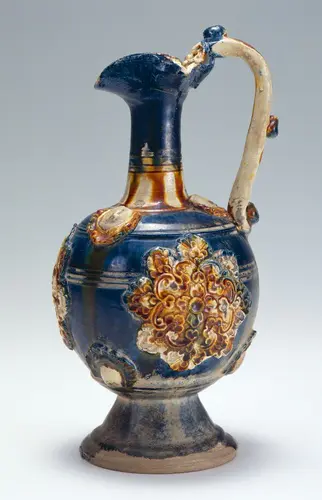
A large gold leaf decoration floats on the water surface. The entire ground is covered with cobalt blue glaze, creating a luxurious atmosphere together with the gold leaf. Cobalt blue glaze is scarce compared to green or brown glaze, making the three-color effect even more luxurious. The form of the water container is reminiscent of the Sasan period, and the addition of cobalt blue intensifies the already eccentric atmosphere.
大きな宝相華文の貼花が器に飾られた水注。地には藍釉が全体に掛かり、宝相華文とともに、豪奢な雰囲気を漂わせている。藍釉はコバルトであり、緑釉や褐釉に比べ、希少であり、それがふんだんに使われていることがこの三彩をより豪奢にみせている。水注の姿はササン朝風であり、藍釉が加わり、よりエキゾチックな雰囲気を強めている。
View the original at Japan Search →It protects not the buildings but the setting that holds them. Article 2 defines historic landscape as land where structures and remains of historical significance form a single whole with the surrounding natural environment, which is the legal way of saying the hills, the approaches and the sightlines. The ancient capitals are Kyoto, Nara and Kamakura, plus any other municipality added by Cabinet Order. The Minister of Land, Infrastructure, Transport and Tourism designates a preservation area; city planning then carves a Special Preservation District over its core, and inside that district an owner needs permission from the prefectural governor to build, to fell timber, or to change the shape of the ground.
The cool part. It legislates the view, and then it pays for it. Article 10 requires the prefecture to compensate an owner who suffers loss because permission was refused. Article 12 goes further: where refusal seriously impairs the use of the land, the owner can require the prefecture to buy it, at market value. So the state does not merely tell you what the horizon behind a temple may look like. It agrees to purchase the land rather than let the skyline change. Two more things worth knowing. The prefecture must physically sign the district boundary, and a landowner may not obstruct the sign without just cause. And the ministry holding the pen is Transport, not Culture.
Verify at e-Gov 法令検索 →Use it The border is the idea. Use it as an edge treatment and leave the centre empty.
Description source: museum curator text, translated — not generated