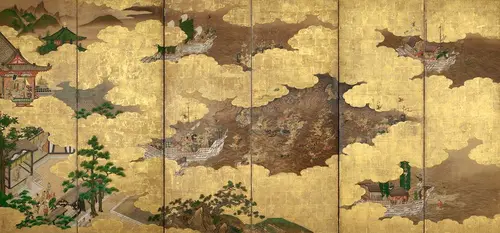
The Great Headdress" is a popular theme for the dance of the young Joyous in Fujita Hidesato's depiction of the Pearl Thief Battle between Fujita Katsukawa and Ryuou. A precious pearl brought from China was stolen by Ryuou, and a maidservant received a request from Katsukawa to retrieve it. Katsukawa, who obtained the Great Headdress, the highest position in the thirteen-tiered headdress, was the only person to have done so. Therefore, the Great Headdress became Katsukawa's alias. This scroll painting skillfully constructs this story and is a valuable work. Currently, it is an important painting attributed to the little-known painter "Kawanabe Kyosai (Okyo)".
「大職冠」は藤原鎌足と竜王の宝珠争奪戦を描いた幸若舞の人気の演題。中国から日本に運ばれる宝珠が竜王に奪われ、鎌足の依頼を受けた海女がそれを取り戻す筋書。冠位十三階の最高位である大職冠を得た唯一の人物であることから、大職冠は鎌足の異名となった。本屏風はこの物語を巧みに構成した優品であることから、現在まで詳細が不明の画家「法橋(山本)元休」を知る重要作品と位置づけられる貴重な屏風である。
View the original at Japan Search →It protects not the buildings but the setting that holds them. Article 2 defines historic landscape as land where structures and remains of historical significance form a single whole with the surrounding natural environment, which is the legal way of saying the hills, the approaches and the sightlines. The ancient capitals are Kyoto, Nara and Kamakura, plus any other municipality added by Cabinet Order. The Minister of Land, Infrastructure, Transport and Tourism designates a preservation area; city planning then carves a Special Preservation District over its core, and inside that district an owner needs permission from the prefectural governor to build, to fell timber, or to change the shape of the ground.
The cool part. It legislates the view, and then it pays for it. Article 10 requires the prefecture to compensate an owner who suffers loss because permission was refused. Article 12 goes further: where refusal seriously impairs the use of the land, the owner can require the prefecture to buy it, at market value. So the state does not merely tell you what the horizon behind a temple may look like. It agrees to purchase the land rather than let the skyline change. Two more things worth knowing. The prefecture must physically sign the district boundary, and a landowner may not obstruct the sign without just cause. And the ministry holding the pen is Transport, not Culture.
Verify at e-Gov 法令検索 →Use it Palette for a single-colour run: one ink, heavy stock, nothing else on the sheet.
Description source: museum curator text, translated — not generated