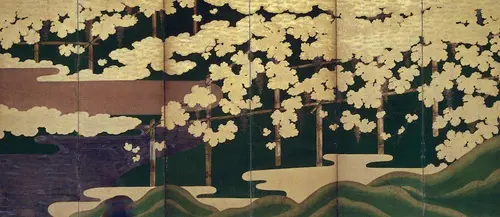
A multitude of grapes, swollen with ripeness, intertwine with bamboo scaffolding, spreading across the entire screen and evoking the generous autumn atmosphere. The depiction of grapes and white puffs, which can be regarded as artistic techniques, is created by the pile-on method. The grape leaves and white clouds decoratively fulfill their roles in the lower half of the screen, where earthen mounds and flowing water are depicted, adding variation and depth to the overall work. This representation method, which takes up one season, autumn, and depicts grapes in a grand manner, can be considered a typical scheme of Tawarayama screens.
たくさんの実を実らせた葡萄が竹の棚に絡まりながら画面全体に広がり、豊饒な秋の情趣を偲ばせる。工芸的技法ともいえる胡粉による盛り上げ彩色によって描き出された葡萄の葉と金雲は装飾的な役割を果たしている。画面下半分に土坡と水流が描き、全体に変化と奥行きを与えている。本作のように季節の一つに秋を取り上げ、その景物としての葡萄を大振りに描くという単純明快な表現方法は、桃山の障屏画の典型的な図案といえる。
View the original at Japan Search →Article 1 sets a purpose larger than preservation: to preserve cultural properties AND to make use of them, contributing to the cultural advancement of the people and to the progress of world culture. Article 4 turns that outward. An owner must recognise the object as a precious national asset, preserve it for the public, and make it public as far as possible. Ownership here carries a duty to show.
The cool part. "Living National Treasure" appears nowhere in the statute. Article 71 requires that when an Important Intangible Cultural Property is designated, the minister must also certify its holder or holding group. Japan does not register the pot, it registers the potter. Article 96 is the one that reaches ordinary people: if you uncover a shell mound, a dwelling site or a tumulus, you must leave it exactly as it is and notify the Commissioner for Cultural Affairs without delay, and the Commissioner can freeze the ground for up to three months.
Verify at e-Gov 法令検索 →Use it The border is the idea. Use it as an edge treatment and leave the centre empty.
Description source: museum curator text, translated — not generated