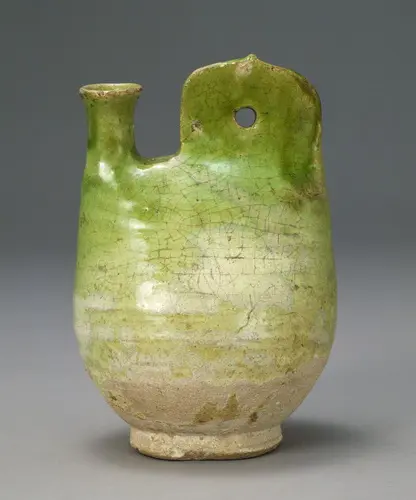
This museum exhibit represents the Yakiware style from the Chitan dynasty, a pastoral civilization. Its distinctive form resembles a leather bag used by pastoral people to carry water or alcohol. This Yakiware vessel has a rounded base and a bulging, wide-necked body above it, with a tube-shaped spout and a large, flat handle resembling a lotus leaf. The bulging body and large handle are older styles for this type of Yakiware. A white pigment is applied after the initial firing, followed by a low-temperature green glaze.
遊牧民族である契丹族の王朝である遼を代表するやきものが皮嚢壺である。その特徴的な形は、遊牧民の生活で水や酒を運ぶ時に用いられる革袋をかたどったものである。この皮嚢壺は、下方がふっくらとし、上方がすぼまった胴部を持ち、その上には、やや横に広がった筒型の注口と、蓮弁形の大きな釣手が付く。胴部が膨らみ、大きな釣手の付くこの形は、皮嚢壺の中でも、より古い型式である。白化粧の後に低火度の緑釉をかける。
View the original at Japan Search →Japan implementing the 1970 UNESCO Convention. When a foreign state reports that cultural property has been stolen from an institution, the Ministry of Foreign Affairs notifies the education ministry, which designates the object as specified foreign cultural property, after consulting the trade ministry. Importing a designated object then requires approval under the foreign exchange and trade law.
The cool part. Article 6 quietly rewrites private law. Under the Civil Code a good-faith purchaser is normally secure against a recovery claim after two years. For designated stolen foreign cultural property, the victim may demand recovery from two years after the theft until ten years have passed. Buying in good faith does not settle the question for a decade, which is roughly how long it takes a stolen object to surface on a legitimate market.
Verify at e-Gov 法令検索 →Use it Two-colour foil on uncoated stock gets you most of this at production cost.
Description source: museum curator text, translated — not generated