Huang Goodman · Art Forgotten

Art Forgotten

Art from public museum collections. A mismatched real Japanese law, and some other factoids.

Every object, image and description comes from the museum's own catalogue record, and every object links to its original. Japanese records are machine-translated into English; the museum's Japanese is kept beside the translation because it is the authoritative form. Each law carries its official number and links to e-Gov 法令検索, the Japanese government's statute database.

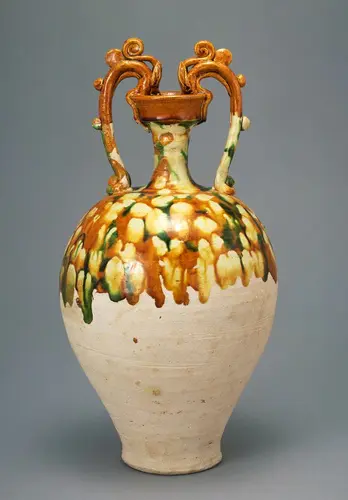
三彩龍耳瓶
{三彩龍耳瓶 · Maker unrecorded · 唐(7-8世紀) / Tang dynasty (7-8 C.) · Japan Search · 国立国会図書館}
Three-colored dragon ear bottle. This bottle, displaying the design of a dragon with three-colored ears, is a notable piece in our collection. The intricate detailing on the dragon's body and the vibrant colors used to depict its scales add to its beauty and charm. The ear of the dragon, adorned with the three distinct hues, lends an interesting and unique touch to this artifact. Crafted with a high level of skill and care, the bottle's shape is well-balanced, making it a pleasure to hold and examine closely. The fusion of the dragon motif, an ancient symbol of power and prosperity, with the three-colored design adds depth and intrigue to this piece. The origins of this bottle remain a mystery, but its presence in our museum allows us to appreciate and learn about the rich history of Japanese art and design. We hope that visitors to our museum will be captivated by the allure of this three-colored dragon ear bottle and gain a newfound appreciation for the artistic traditions of Japan.

A hand reaches from each shoulder of the bottle, grasping the neck. It is called an amphora shape, but there is no particular relation. The hands are dragon-shaped, resembling the posture of a dragon about to drink from the center of the water in Bronze Age Chinese art. The shoulders are decorated with a tri-colored glaze.

瓶の左右の肩から把手が伸びて口縁に取り付いている。アンフォラ形と呼ばれるが、とくに関係はない。把手は龍形で、あたかも中の水を飲もうとする龍の姿は商周青銅器からみられる形である。肩から胴に三彩釉を斑掛けしている。

View the original at Japan Search →
The law
屋外広告物法
Outdoor Advertising Act
昭和二十四年法律第百八十九号 · Act No. 189 of 1949

Article 1 gives three grounds for regulating a sign: forming good landscape, maintaining scenic character, and preventing danger to the public. Article 3 then lets a prefecture prohibit outdoor advertising outright, by ordinance, in named categories of place.

The cool part. Read the list in Article 3 and it stops being an advertising law. The places where signage can be banned include landscape districts, scenic districts, preservation districts for groups of traditional buildings, the surroundings of designated Important Cultural Properties, and historic sites, places of scenic beauty and natural monuments. The statute protects the view by removing the sentences written across it.

Verify at e-Gov 法令検索 →

Use it The border is the idea. Use it as an edge treatment and leave the centre empty.

Description source: museum curator text, translated — not generated