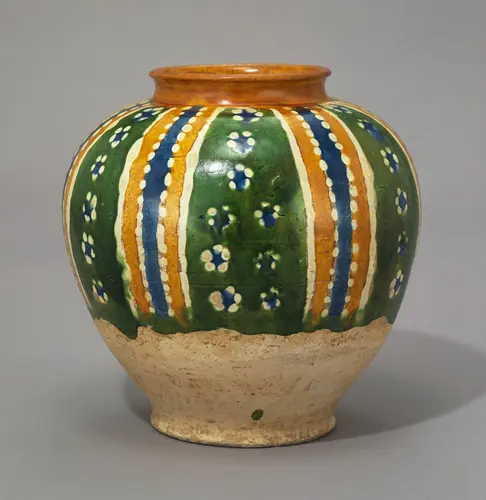
Three-color pottery is first fired at high temperatures for priming, then coated with underglaze and fired again at around 800 degrees for glazing. Excavations at the Yanghi Kiln Site in Henan Province have unearthed primed, glazed, and three-colored pottery. This three-color pottery has green, brown, and blue underglazes stacked vertically, with white circular patterns scattered in the green underglaze. It was previously thought that the white circular patterns were created by placing a bowl upside-down during firing. However, recent excavations at the Yanghi Kiln Site have confirmed that the patterns were drawn as circles.
三彩陶器は初めに高火度で素焼きし、その後に鉛釉を施釉して800度前後の低火度で再焼成している。河南省鞏義窯跡の発掘で素焼き、施釉したもの、再焼成した三彩が出土している。この三彩は緑釉、褐釉、藍釉を縦縞に掛け、さらに緑釉のなかに白い花形の円文を散らせている。白い円文は蝋を掛けて釉をはじいたと考えられたが、最近の河南省鞏義窯跡の調査で、模様を円文に描いていることが確認された。
View the original at Japan Search →A national statute written for one city. Article 1 recites the beauty of Kyoto and its historically, culturally and artistically important position in the world, and gives two purposes: to raise international culture and serve the ideal of permanent world peace, and to contribute to the economic recovery of Japan. It was passed five years after the war ended.
The cool part. Article 3 lets Kyoto designate culture tourism preservation districts and, by ordinance, prohibit building, rebuilding, removal, changes to the shape of the land and the cutting of bamboo, trees and stone, with compensation for ordinary loss. Then Article 4 does something statutes almost never do. It places a duty on the mayor personally: in the spirit of local autonomy, and with the cooperation of residents, the mayor must engage in ceaseless activity to complete the city. Nara received its own Act, number 250, the day before.
Verify at e-Gov 法令検索 →Use it A motif small enough to blind-deboss, which is where restraint actually shows.
Description source: museum curator text, translated — not generated