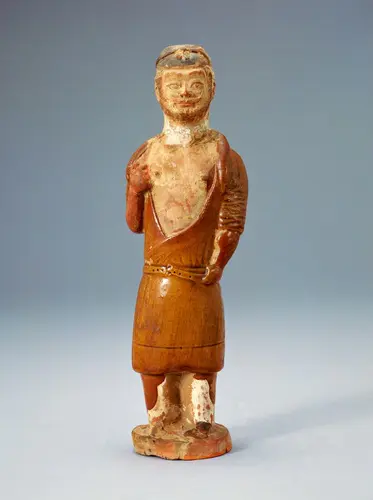
A camel was followed by animals or depicted in wall paintings only from the Northern Wei Dynasty onwards. This was not unrelated to the fact that the Xianbei people joined the Northern Wei Dynasty. In the Loushan Tomb (570 AD) in Shanxi Province, there is a group image of camels painted on the walls. The man with a beard is a Hu person. Hu people were merchants from Central Asia. They used camels as transportation and transported Western treasures. This Hu person was also someone who led the camels. He wore a coat made of animal skins.
駱駝をかたどった動物や、壁画に駱駝が描かれるのは北朝時代以降である。それは鮮卑族が北朝に加わるようになったことと無関係ではない。山西省太原の楼叡墓(570年)の壁画には駱駝の群像が描かれている。この髭を蓄えた男は胡人。胡人とはソグド人で、中央アジアに源をもつ商業民族である。駱駝を運送手段に、西方の珍宝を運んだのである。この胡人も駱駝を引く御者である。身には皮のコートを羽織っている。
View the original at Japan Search →Article 1 gives three grounds for regulating a sign: forming good landscape, maintaining scenic character, and preventing danger to the public. Article 3 then lets a prefecture prohibit outdoor advertising outright, by ordinance, in named categories of place.
The cool part. Read the list in Article 3 and it stops being an advertising law. The places where signage can be banned include landscape districts, scenic districts, preservation districts for groups of traditional buildings, the surroundings of designated Important Cultural Properties, and historic sites, places of scenic beauty and natural monuments. The statute protects the view by removing the sentences written across it.
Verify at e-Gov 法令検索 →Use it Take the ratio, not the picture. It sets a page better than a grid does.
Description source: museum curator text, translated — not generated