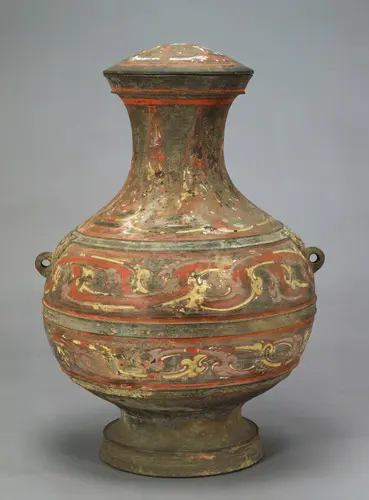
Before firing, this earthenware pottery has inscriptions drawn on it. This pot is inscribed after it has been fired. The surface of the ceramic piece is decorated with various colors such as red, gray, and purple using painting tools. In the tombs of the Warring States period in the northern region, such metal and lacquer ware were often buried as secondary burials. The Terracotta Army of the First Emperor of Qin was also fully colored. In the Han tombs of the southern region, there are fewer painted ceramics and more gray-glazed pottery instead.
焼成前に文様を描いている彩陶に対し、この壺は焼いた後に施文している。土器の上に、赤、灰、紫などの絵具で、雲気文、鋸歯文などの文様を描いている。華北の戦国時代の墓にはこうした金属器、漆器を写した土器が副葬されることが多い。秦始皇帝兵馬俑も全身に彩色されていた。華南の漢墓からは加彩土器は少なく、灰釉陶器がそれに代わることが多い。
View the original at Japan Search →Article 2 defines a museum as an institution that collects, keeps and displays materials on history, art, folklore, industry and natural science for public use, carries out research on them, and which has been registered under Chapter 2 of this Act. The registration is not decorative. In law, an unregistered collection open to the public is not a museum.
The cool part. The definition of keeping is given as including raising. That single parenthesis is why a zoo, an aquarium and a botanical garden sit inside museum law in Japan: the collection is allowed to be alive. Article 1 also grounds the statute in the Social Education Act and the Basic Act on Culture and the Arts, which places museums in education first and culture second.
Verify at e-Gov 法令検索 →Use it Two-colour foil on uncoated stock gets you most of this at production cost.
Description source: museum curator text, translated — not generated