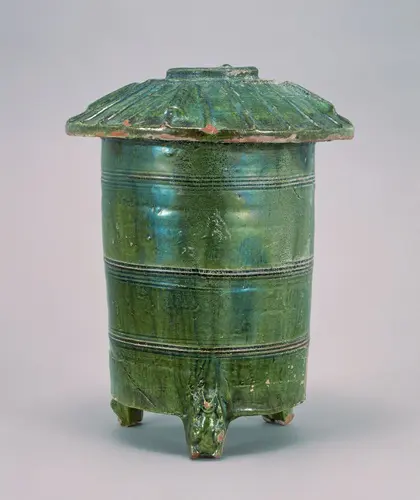
A barn is a grain storage facility. There are still such barns in the northern countryside today. They have cylindrical bodies, umbrella-shaped roofs, and pig-shaped feet. During the Han Dynasty, such ceramicware as pigsties, wells, birdhouses, towers, and this type of barn were popular, providing interesting insights into life during that time. This piece is glazed and has a vibrant green color. It dates from the middle Han Dynasty, around the 1st to 2nd century.
囷は穀物倉庫。今日でも華北の農村にはこうした形の穀物倉庫がある。筒形の胴に、傘形の屋根が付く。足は熊形。漢時代の明器には豚舎、井戸、鳥小屋、楼閣、塔、そしてこのような囷などがあり、この時代の生活風景を考えるには興味深い資料である。この作品は作行、緑釉の発色とも鮮やかである。後漢時代中期、1~2世紀の作である。
View the original at Japan Search →Article 1 states the purpose plainly: prevent trade in stolen goods, find them quickly, and speed the recovery of victims. Article 2 then defines a used article to include, in the same breath, art objects held for appreciation. Dealing in them requires a licence.
The cool part. Article 16 requires a dealer to record every transaction: the date, the item and quantity, its distinguishing features, and the address, name, occupation and age of the other party. Article 15 requires that a dealer who suspects an item is stolen report it to a police officer immediately. So the antique trade runs on a register the police may read, and a painting becomes a second-hand article the moment it has been used once.
Verify at e-Gov 法令検索 →Use it Two-colour foil on uncoated stock gets you most of this at production cost.
Description source: museum curator text, translated — not generated