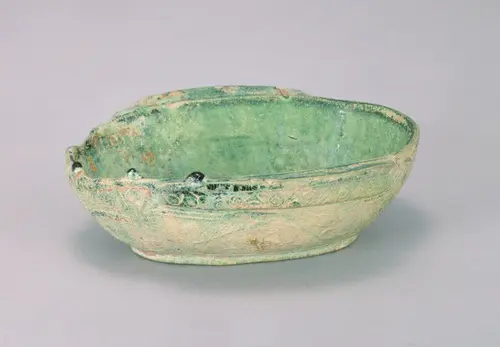
This is a beautiful ear cup made of silver. An ear cup is a cup with a curved handle along the longest side, which is round in shape. Earthenware ear cups are common and many have been excavated from Han tombs in the southern regions. There is also a silver ear cup (permanent collection of the Longyang Jin Village Ancient Site Museum) among the excavated items from the ancient tomb site of Longyang Jin Village. The rim of the mouth of this ear cup is in the form of droplets. It was fired in an upside-down position, as evidenced by the difference in the color of the exterior and interior. An ear cup is a type of drinking vessel. This ear cup was used as a funeral gift for the deceased to enjoy a banquet in the underworld.
銀化の美しい耳杯である。耳杯は楕円形の杯の長辺に弧形の把手が付く。漆器が一般的であり、華南の漢墓から多く出土している。洛陽金村古墓出土品には、銀製耳杯(永青文庫蔵)がある。この耳杯の口縁の釉は滴状になっている。上下を逆にして焼いたためである。耳杯は酒器である。この耳杯は、死者が冥界での宴席で、酒宴を楽しむように副葬されたのである。
View the original at Japan Search →Article 3 tells libraries what to gather, and the list is wider than books: local materials, local administrative records, works of art, records and film. Article 3 also requires interlibrary lending, travelling collections and mobile libraries, so that the holdings move toward the reader rather than waiting.
The cool part. Article 17 is one sentence and admits nothing. A public library may not collect an admission fee, or any consideration whatsoever, for the use of library materials. Free is not a policy that a budget round can revisit, it is the statute. Article 26 is stranger still: the state and local authorities must not interfere in the work of a private library, and must not give it a subsidy. Independence is protected by withholding the money.
Verify at e-Gov 法令検索 →Use it A motif small enough to blind-deboss, which is where restraint actually shows.
Description source: museum curator text, translated — not generated