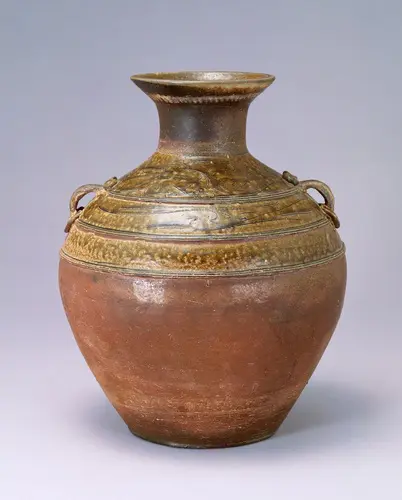
A green-glazed jar with the same shape as a double-ear jar. The green-glazed double-ear jar has a notably short neck, but this jar has a neck part that is tubular in shape and has a rim that resembles a lap. The glazing is applied only on the shoulders and features three protrusions with inscribed lines depicting birds. This type of gray-glazed ceramic is produced in a kiln in the suburbs of Hangzhou, Zhejiang Province. It is from the same region as the ancient kilns that made primative green pottery. However, by the late Han Dynasty period, this type of jar had lost its distinctive form.
緑釉双耳壺と同じ形の炻器の壺。緑釉双耳壺は頸がきわめて短いが、この壺は筒形の頸部に、ラッパ形の口縁が伸びる。施釉は肩だけで、3段の突帯のなかに、線文で鳥を意匠化した文様を巡らせている。このタイプの灰釉陶器は浙江省杭州近郊の窯で作られている。いわゆる原始青磁を焼いた窯と同じ地域であるが、後漢時代後期にはこのタイプの炻器は姿を消す。
View the original at Japan Search →A national statute written for one city. Article 1 recites the beauty of Kyoto and its historically, culturally and artistically important position in the world, and gives two purposes: to raise international culture and serve the ideal of permanent world peace, and to contribute to the economic recovery of Japan. It was passed five years after the war ended.
The cool part. Article 3 lets Kyoto designate culture tourism preservation districts and, by ordinance, prohibit building, rebuilding, removal, changes to the shape of the land and the cutting of bamboo, trees and stone, with compensation for ordinary loss. Then Article 4 does something statutes almost never do. It places a duty on the mayor personally: in the spirit of local autonomy, and with the cooperation of residents, the mayor must engage in ceaseless activity to complete the city. Nara received its own Act, number 250, the day before.
Verify at e-Gov 法令検索 →Use it Take the ratio, not the picture. It sets a page better than a grid does.
Description source: museum curator text, translated — not generated