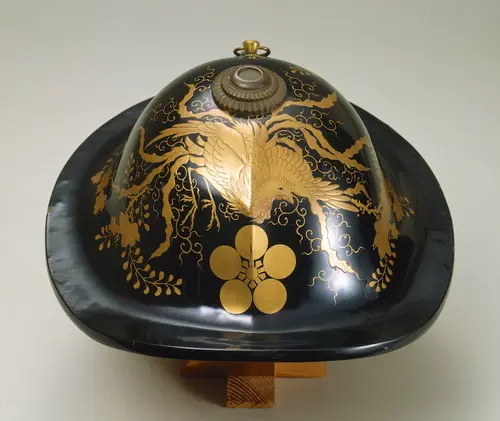
Thick lacquer covers the front, reflecting black paint on its surface. In the front and center, a phoenix is depicted. Below, there is a mei-boku mon (mei-boku being a type of crest) with its edges raised. On both sides, there are patterns imitating Paulownia trees. In the center of the back and front, a three-leaf mei-boku mon is placed. The scope includes both the lacquer and the gold leaf painting.
厚い煉革の前方を反らせ黒漆塗りで、前方正面の中に鳳凰を、下方に梅鉢紋をほどこし、左右に桐の模様を金蒔絵にして、後方正面の中心に三ツ割の梅鉢紋を置く。作域は、漆及び蒔絵ともにすぐれている。
View the original at Japan Search →Article 1 sets a purpose larger than preservation: to preserve cultural properties AND to make use of them, contributing to the cultural advancement of the people and to the progress of world culture. Article 4 turns that outward. An owner must recognise the object as a precious national asset, preserve it for the public, and make it public as far as possible. Ownership here carries a duty to show.
The cool part. "Living National Treasure" appears nowhere in the statute. Article 71 requires that when an Important Intangible Cultural Property is designated, the minister must also certify its holder or holding group. Japan does not register the pot, it registers the potter. Article 96 is the one that reaches ordinary people: if you uncover a shell mound, a dwelling site or a tumulus, you must leave it exactly as it is and notify the Commissioner for Cultural Affairs without delay, and the Commissioner can freeze the ground for up to three months.
Verify at e-Gov 法令検索 →Use it Two-colour foil on uncoated stock gets you most of this at production cost.
Description source: museum curator text, translated — not generated