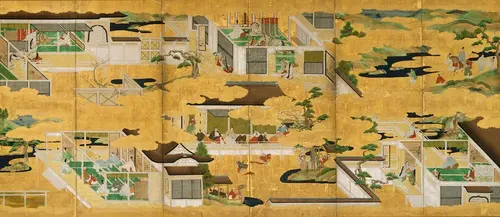
The story of "Genji" was used as inspiration for this painting, which is called "Genji art." It is believed that the painting of this work began not long after the establishment of the original text. Throughout the Middle Ages and Late Periods, it was depicted in various painting styles. This theme became a common and classical subject in Japanese painting. This work belongs to the Edo period and is influenced by the painting style of Kobayashi Kiyochika. The painting divides the scene into sections using gold clouds and walls. Twelve scenes are arranged, including "Sakura" and "Asaji." In the upper left corner, the scene of "Tamaudemi" is depicted, showing Genji selecting clothing for a new year's gift and the figure of the Empress.
『源氏物語』を題材にした絵を「源氏絵」といい、原典成立後まもなく絵画化が始まったとされる。以後、中世、近世を通じて、様々な画派によって描かれ、日本絵画の普遍的・古典的テ−マとなった。本作は江戸前期に活躍した岩佐又兵衛の作風に近く、画面を金雲や塀で区分し、源氏物語五十四帖から選ばれた、「桐壺」「明石」など計12場面を配している。左隻上部には「玉鬘」の場面が描かれ、新春に贈る衣装を選ぶ光源氏と紫の上の姿がある。
View the original at Japan Search →A statute built to coax privately held work onto public walls. An owner registers a piece with the Commissioner for Cultural Affairs, then contracts with a museum to display it. Article 2 defines a work of art broadly, as paintings, sculpture, crafts and other tangible cultural products that are movable, which is the legal way of saying anything you could carry out of the house.
The cool part. The terms are the interesting part. Article 2 requires the public display contract to run for five years or more, and to contain a clause stating that the parties may not give notice of cancellation. You cannot lend a masterpiece for the tax treatment and then reclaim it when the market turns. Japan concluded the barrier to seeing art was never storage. It was ownership, and the fix was a contract you cannot walk out of.
Verify at e-Gov 法令検索 →Use it Take the ratio, not the picture. It sets a page better than a grid does.
Description source: museum curator text, translated — not generated