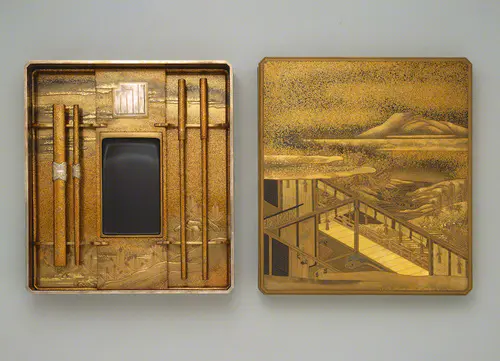
The image of "Hatsune (First Child)" was inspired by the scene in the "Tale of Genji" titled "First Child." The name "First Child" is also associated with "Hatsune (First Child)". Hatsune was well-liked as the one who arranged wedding ceremonies. The image has a rich and subtle background of a plum garden, with gold pictures and ema (wooden plaques) pasted on it. Partially, vermilion and blue pigments are used. The scene includes a room in the Six Barrier Temple, a young pine tree, a plum tree, and so on. The intended arrangement is to place a young pine tree in the dense plum garden, and a water droplet embedded in the central lower water basin is designed as Genji Fragrance. These items include a scatter of plum blossoms in a pine painting. The artist's seal suggests that the painter was active in Kyoto from the late Edo period to the early Meiji period.
「初音(はつね)」は『源氏物語』「初音」の巻の情景を意匠化した図柄で、「初音」はまた「初子(はつね)」に通じ、婚礼の調度の意匠としても好まれた。濃淡をつけた叢梨地を背景に高蒔絵や金板を貼り込み、部分的に朱や青の彩漆を使うなどして六条院の部屋、若松や梅のある庭、梅樹などが描写されている。見込みは詰梨地に若松を配し、硯のほか中央下水板に嵌め込まれた水滴は源氏香がデザインされ、筆架に筆2本、刀子、錐を納める。これら内容品には詰梨地に梅花を蒔絵で散らしている。作者の象彦は江戸時代末期から明治初期にかけて京都で活躍した蒔絵師である。
View the original at Japan Search →A statute built to coax privately held work onto public walls. An owner registers a piece with the Commissioner for Cultural Affairs, then contracts with a museum to display it. Article 2 defines a work of art broadly, as paintings, sculpture, crafts and other tangible cultural products that are movable, which is the legal way of saying anything you could carry out of the house.
The cool part. The terms are the interesting part. Article 2 requires the public display contract to run for five years or more, and to contain a clause stating that the parties may not give notice of cancellation. You cannot lend a masterpiece for the tax treatment and then reclaim it when the market turns. Japan concluded the barrier to seeing art was never storage. It was ownership, and the fix was a contract you cannot walk out of.
Verify at e-Gov 法令検索 →Use it The border is the idea. Use it as an edge treatment and leave the centre empty.
Description source: museum curator text, translated — not generated