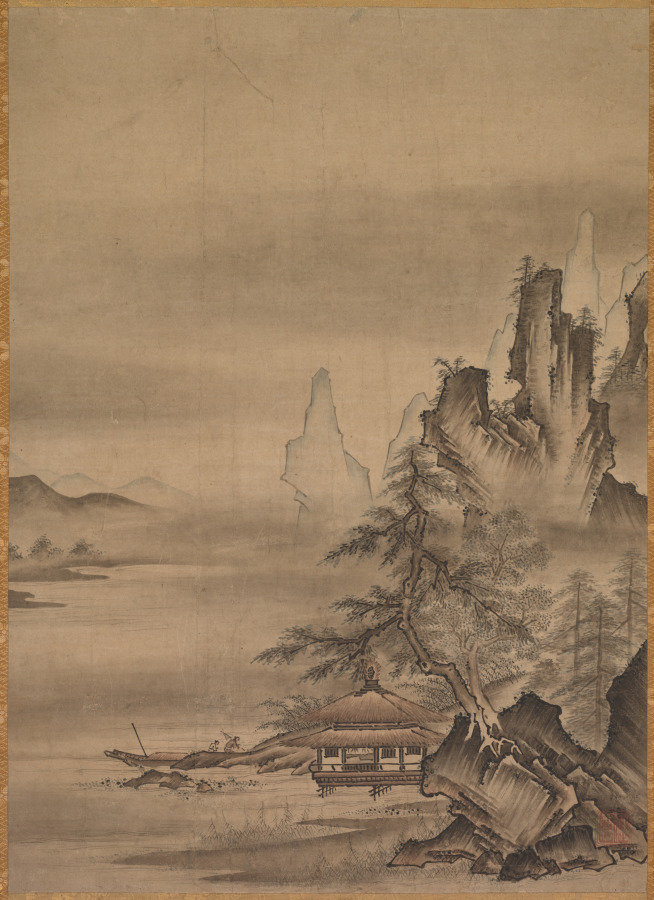
This painting bears a seal reading Shōkei. The style of the seal resembles that used by Kenkō Shōkei (active about 1470–after 1523), a monk and painter at the Zen temple Kenchōji in Kamakura who studied in Kyoto for three years with Geiami (1431–1485?), painter to the shogun as well as curator of the shogun’s collection of art. However, the seal was carved to look like Shōkei’s and added to the painting at a later date by someone who thought the unsigned landscape was similar to his work. The painting has compositional and some stylistic similarities to images by other Kanto-based artists like Maejima Sōyū (active mid-1500s), who trained with Kano school artists. Specifically, the pines clinging to the massive boulder in front of a pavilion with mountains receding into atmospheric space—in a composition weighted in a single corner of the painting—is a Kanto-inflected derivation of the painting of the Zen monk-painter Tenshō Shūbun (active about 1414), whose work was a major inspiration for Kano school painters.
View the original at Cleveland Museum of Art →Japan implementing the 1970 UNESCO Convention. When a foreign state reports that cultural property has been stolen from an institution, the Ministry of Foreign Affairs notifies the education ministry, which designates the object as specified foreign cultural property, after consulting the trade ministry. Importing a designated object then requires approval under the foreign exchange and trade law.
The cool part. Article 6 quietly rewrites private law. Under the Civil Code a good-faith purchaser is normally secure against a recovery claim after two years. For designated stolen foreign cultural property, the victim may demand recovery from two years after the theft until ten years have passed. Buying in good faith does not settle the question for a decade, which is roughly how long it takes a stolen object to surface on a legitimate market.
Verify at e-Gov 法令検索 →Use it Palette for a single-colour run: one ink, heavy stock, nothing else on the sheet.
Description source: museum curator text — not generated