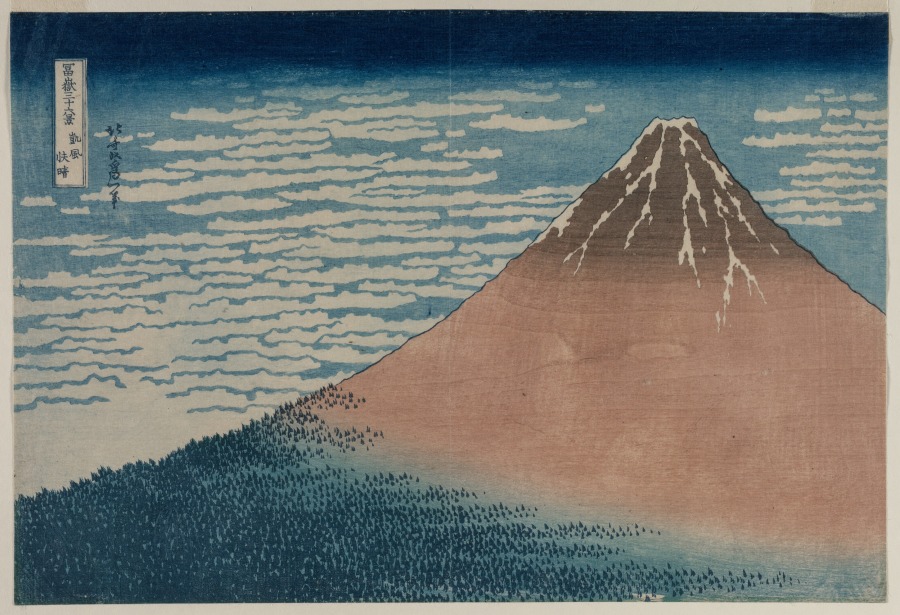
Mt. Fuji, Japan’s highest mountain, appeared in most Japanese 19th-century travel literature. Maps sometimes showed its location with a Fuji-shaped icon and indicated where travelers could get the best view of it. Between 1829 and 1833, Hokusai created a print series depicting thirty-six views of the mountain, including this one, sometimes known as “Red Fuji.” The season in this scene is a time between late summer and early autumn, when the mountain takes on a reddish hue.
View the original at Cleveland Museum of Art →A statute built to coax privately held work onto public walls. An owner registers a piece with the Commissioner for Cultural Affairs, then contracts with a museum to display it. Article 2 defines a work of art broadly, as paintings, sculpture, crafts and other tangible cultural products that are movable, which is the legal way of saying anything you could carry out of the house.
The cool part. The terms are the interesting part. Article 2 requires the public display contract to run for five years or more, and to contain a clause stating that the parties may not give notice of cancellation. You cannot lend a masterpiece for the tax treatment and then reclaim it when the market turns. Japan concluded the barrier to seeing art was never storage. It was ownership, and the fix was a contract you cannot walk out of.
Verify at e-Gov 法令検索 →Use it A motif small enough to blind-deboss, which is where restraint actually shows.
Description source: museum curator text — not generated