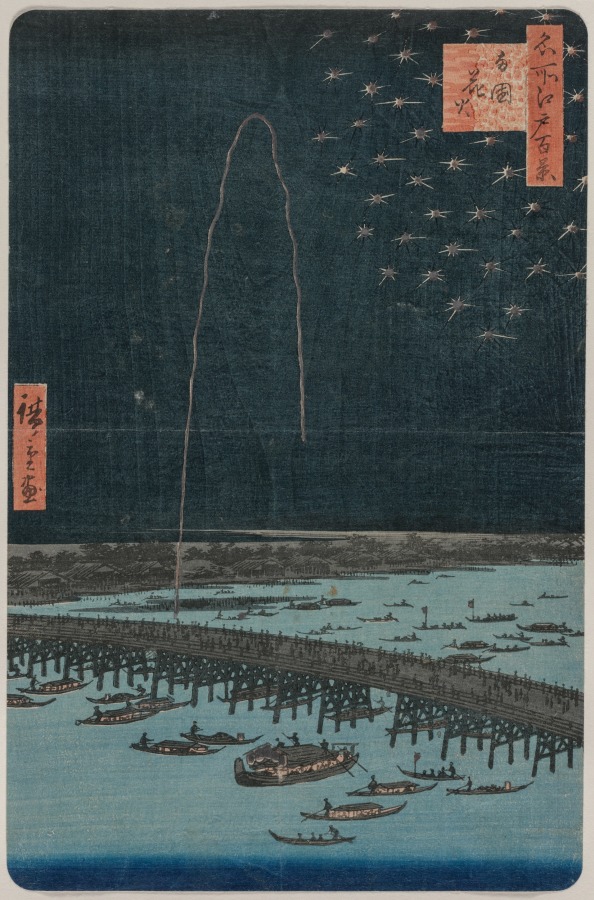
The Ryōgoku Bridge, a repeated subject of Hiroshige’s prints, spanned the Sumida River connecting bustling Edo (present-day Tokyo) neighborhoods. Here, Hiroshige devoted nearly half the composition to the night sky glittering with fireworks. Restaurants and other businesses along the riverbank frequently sponsored these dazzling displays during the 1850s. The pyrotechnics drew large crowds, who gathered atop the bridge, along the shore, in teashops, and on rented pleasure boats to enjoy the show.
View the original at Cleveland Museum of Art →Article 1 states the purpose plainly: prevent trade in stolen goods, find them quickly, and speed the recovery of victims. Article 2 then defines a used article to include, in the same breath, art objects held for appreciation. Dealing in them requires a licence.
The cool part. Article 16 requires a dealer to record every transaction: the date, the item and quantity, its distinguishing features, and the address, name, occupation and age of the other party. Article 15 requires that a dealer who suspects an item is stolen report it to a police officer immediately. So the antique trade runs on a register the police may read, and a painting becomes a second-hand article the moment it has been used once.
Verify at e-Gov 法令検索 →Use it The border is the idea. Use it as an edge treatment and leave the centre empty.
Description source: museum curator text — not generated