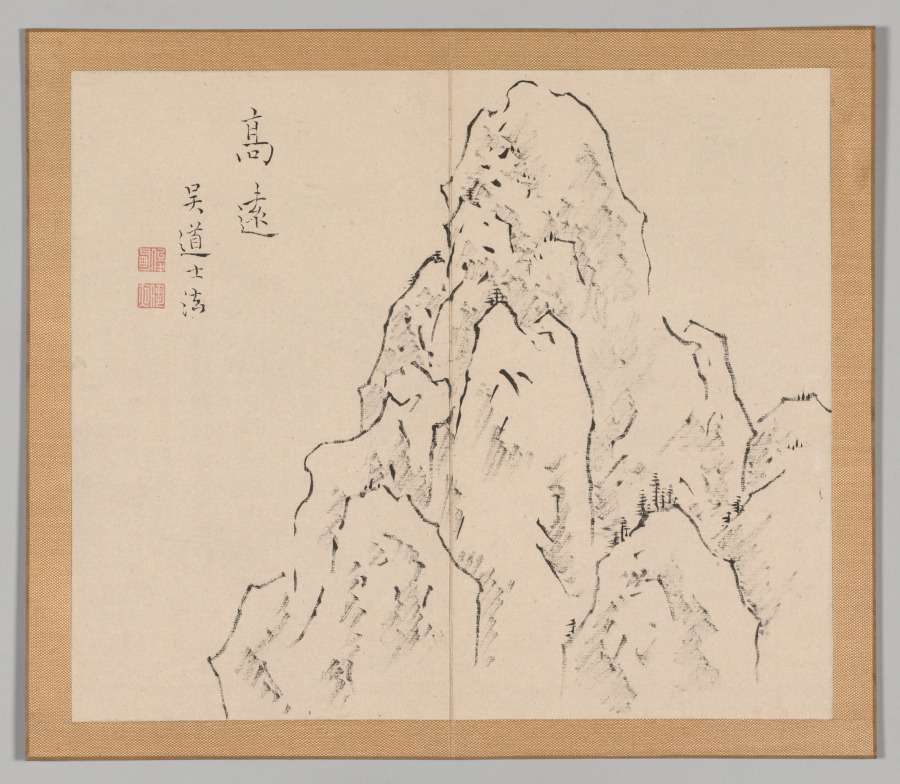
Aoki Shukuya was a student of Ike Taiga and inherited his painting style. A surviving album by Taiga in Kyoto, in scroll form, was the inspiration for this painting by Shukuya and its pairing designs from a 1804 published set of wood-block prints. The third volume of these wood-block prints contains an image of a tall mountain peak with the text "high and distant" to its left. Shukuya's version of this design includes additional words; he wrote that it represents the method of Wu Daozi, a renowned Tang-dynasty painter whose work is known today only through copies. Taiga created the original album for his wife and painter Tokuyama Gyokuran. A postscript in the books, written and carved by scholar Minagawa Kien (1735-1807), provides this information.
Aoki Shukuya was a top student of painter Ike Taiga and took responsibility for Taiga’s stylistic legacy. A painting album by Taiga, part of which survives today in Kyoto in hanging scroll format, served as the source for this painting by Shukuya and the matching designs from a set of wood-block–printed volumes published in 1804. The postscript to the books, written and carved by the scholar Minagawa Kien (皆川淇園) (1735–1807), explains that Taiga produced the original album for his wife and fellow painter Tokuyama Gyokuran (徳山玉瀾) (1727/28–1784). The third volume of the wood-block–printed books contains an image of a tall mountain peak with the text “high and distant” (高遠) to its left. Shukuya’s version of this design includes additional words—he wrote that the design represents the method of Wu Daozi (吳道子) (Chinese, about 689–759). Revered as one of the most important Tang-dynasty painters, Wu Daozi’s work is known today only through copies.
View the original at Cleveland Museum of Art →Article 2 defines a museum as an institution that collects, keeps and displays materials on history, art, folklore, industry and natural science for public use, carries out research on them, and which has been registered under Chapter 2 of this Act. The registration is not decorative. In law, an unregistered collection open to the public is not a museum.
The cool part. The definition of keeping is given as including raising. That single parenthesis is why a zoo, an aquarium and a botanical garden sit inside museum law in Japan: the collection is allowed to be alive. Article 1 also grounds the statute in the Social Education Act and the Basic Act on Culture and the Arts, which places museums in education first and culture second.
Verify at e-Gov 法令検索 →Use it Take the ratio, not the picture. It sets a page better than a grid does.
Description source: museum curator text, translated — not generated