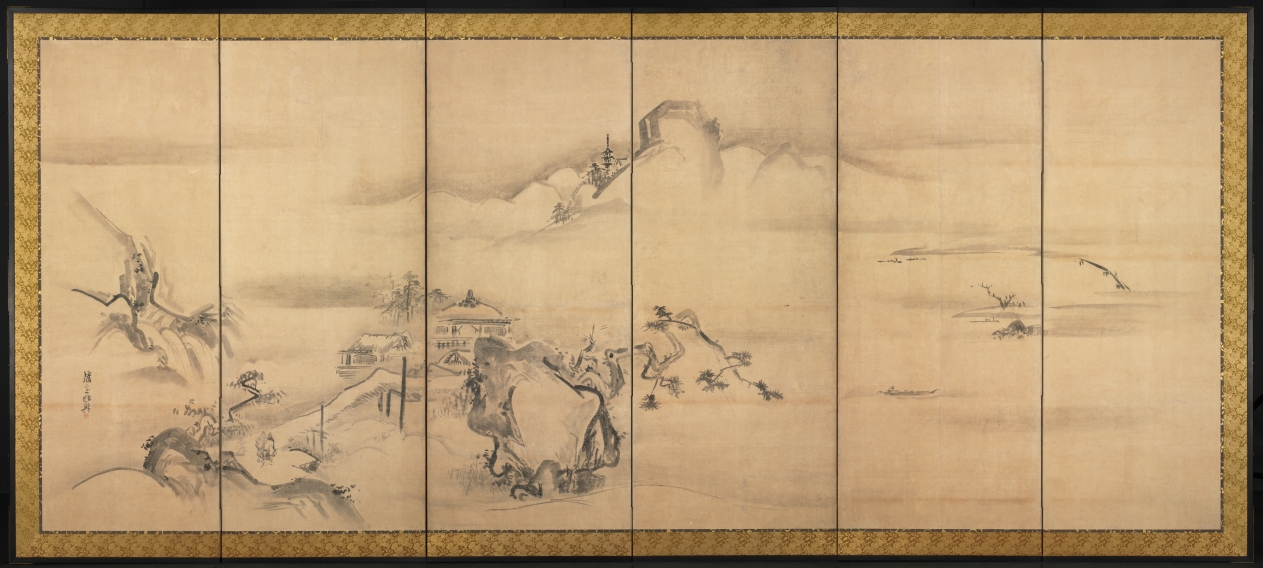
Watanabe Shiko enjoyed a versatile and successful career, as well as a privileged upbringing, in Kyoto. His surviving work indicates a capacity to diligently study, master, and then interpret several painting techniques—each of which varies considerably in appearance. These byobu (folding screens), for instance, reflect training in the Kano school idiom that favored a monochromatic ink palette, vigorous brushwork, and traditional Chinese—rather than Japanese—subject matter. Shiko rendered this scenery in a particularly expansive manner, suggesting the vastness of China's topography relative to Japan's. Frequent visitors to the museum will recall that Shiko also painted the collection's favored pair of byobu, the Irises (CMA 1954.603).
View the original at Cleveland Museum of Art →It protects not the buildings but the setting that holds them. Article 2 defines historic landscape as land where structures and remains of historical significance form a single whole with the surrounding natural environment, which is the legal way of saying the hills, the approaches and the sightlines. The ancient capitals are Kyoto, Nara and Kamakura, plus any other municipality added by Cabinet Order. The Minister of Land, Infrastructure, Transport and Tourism designates a preservation area; city planning then carves a Special Preservation District over its core, and inside that district an owner needs permission from the prefectural governor to build, to fell timber, or to change the shape of the ground.
The cool part. It legislates the view, and then it pays for it. Article 10 requires the prefecture to compensate an owner who suffers loss because permission was refused. Article 12 goes further: where refusal seriously impairs the use of the land, the owner can require the prefecture to buy it, at market value. So the state does not merely tell you what the horizon behind a temple may look like. It agrees to purchase the land rather than let the skyline change. Two more things worth knowing. The prefecture must physically sign the district boundary, and a landowner may not obstruct the sign without just cause. And the ministry holding the pen is Transport, not Culture.
Verify at e-Gov 法令検索 →Use it Take the ratio, not the picture. It sets a page better than a grid does.
Description source: museum curator text — not generated