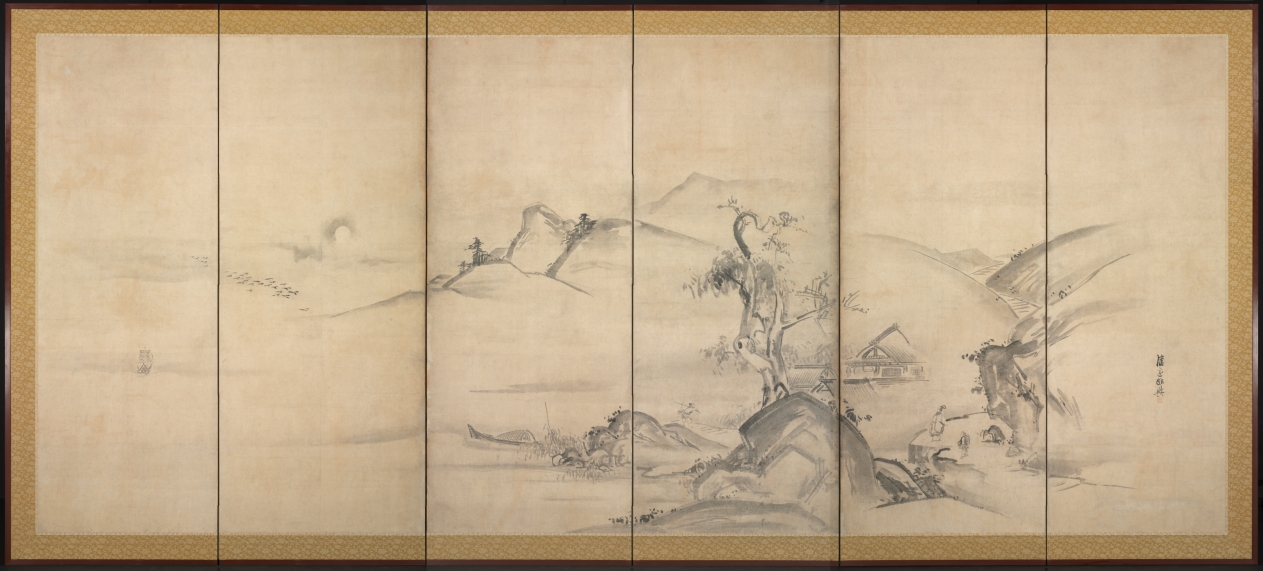
Watanabe Shiko, an Edo period painter who combined Kano school style with Rimpa style, re-created the Xiao and the Xiang rivers on a pair of eight-panel screens. For this composition, he followed the Kano school’s sense of space, adapted from miniature copying paintings (shukuzu) by the Japanese artist Kano Tanyu. Watanabe revised the typical representations of the Xiao and the Xiang rivers by rendering the theme Wild Geese Descending to Sandbar on the right screen and Evening Bell from Mist-Shrouded Temple on the left screen. He depicted simple motifs—moon, boat, geese, and temple—to suggest the other scenes while also creating airy space.
View the original at Cleveland Museum of Art →Article 3 tells libraries what to gather, and the list is wider than books: local materials, local administrative records, works of art, records and film. Article 3 also requires interlibrary lending, travelling collections and mobile libraries, so that the holdings move toward the reader rather than waiting.
The cool part. Article 17 is one sentence and admits nothing. A public library may not collect an admission fee, or any consideration whatsoever, for the use of library materials. Free is not a policy that a budget round can revisit, it is the statute. Article 26 is stranger still: the state and local authorities must not interfere in the work of a private library, and must not give it a subsidy. Independence is protected by withholding the money.
Verify at e-Gov 法令検索 →Use it Take the ratio, not the picture. It sets a page better than a grid does.
Description source: museum curator text — not generated