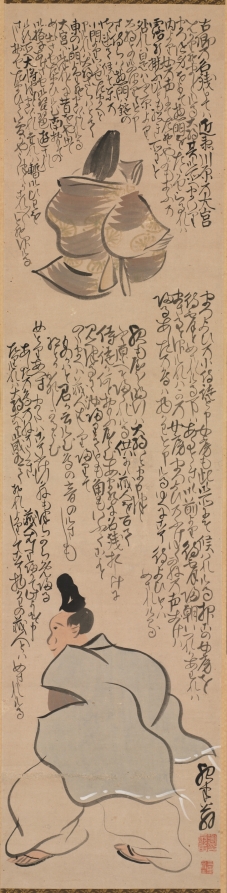
Drawing from Japanese literature, Yosa Buson copied almost the entire text of the “Moon Viewing” episode from The Tale of the Heike, a story of the rise and fall of the Taira family. The two characters he painted were given nicknames based on 31-syllable waka poems they composed. Seen from behind at the top is Matsuyoi, or “Waiting at Nightfall,” while the person striding below is Mono ka wa Kurando, roughly equivalent to “‘It’s Nothing’ Chamberlain.”
View the original at Cleveland Museum of Art →Article 1 states the aim as a beautiful and dignified national land, and it covers not only cities but farming, mountain and fishing villages. Inside a landscape planning area, Article 16 requires advance notification of new building, extension, rebuilding, relocation, and any repair or alteration that changes the exterior. Landscape Districts go further and impose direct restrictions on the form and design of buildings.
The cool part. Read Article 16 to the end of the sentence. A change of colour is listed alongside new construction as an act you must notify. Repainting your building is, in law, the same category of event as putting up a new one. This is the machinery behind the muted shopfronts of Kyoto. The brown coffee-shop sign is not a marketing choice, it is compliance.
Verify at e-Gov 法令検索 →Use it A motif small enough to blind-deboss, which is where restraint actually shows.
Description source: museum curator text — not generated