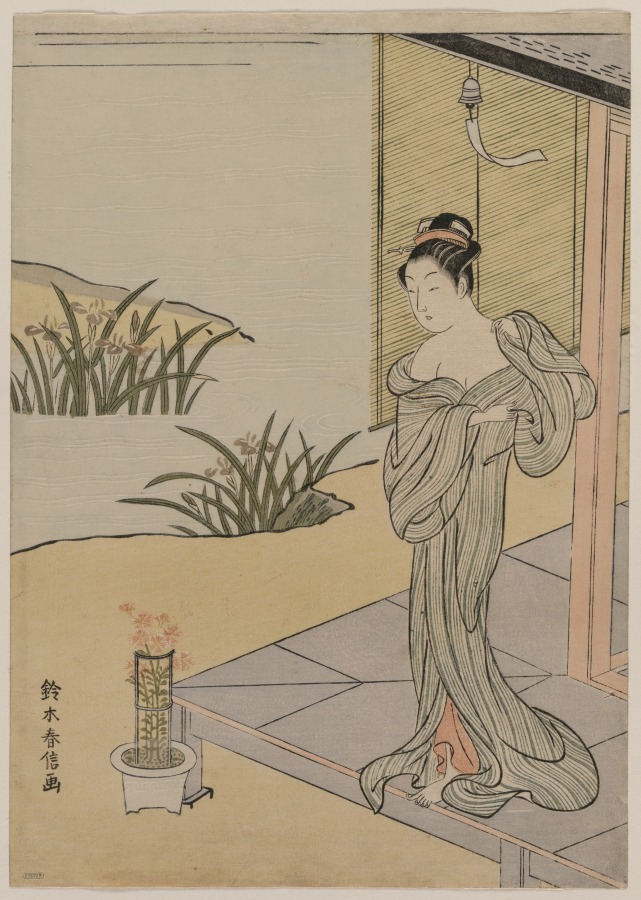
A girl steps onto a veranda after a bath to look at a pot of pinks. A warm breeze stirs the poem-strip tied to the windbell above her. Irises bloom in the pool in the background. The print has been identified as the summer subject in a set of four flowers representing each season and is considered to be one of Harunobu’s most enchanting designs. One of the most celebrated and productive of all ukiyo-e artists, Harunobu is widely recognized as the first Japanese printmaker to create designs by printing each color in the image with a different block. These prints came to be known as nishiki-e, or brocade pictures, suggesting their resemblance to the gorgeous brocades worn at the time. The embossing on the waves in the stream and on the flowers was created by using unpigmented blocks during the printing process.
View the original at Cleveland Museum of Art →Article 1 sets a purpose larger than preservation: to preserve cultural properties AND to make use of them, contributing to the cultural advancement of the people and to the progress of world culture. Article 4 turns that outward. An owner must recognise the object as a precious national asset, preserve it for the public, and make it public as far as possible. Ownership here carries a duty to show.
The cool part. "Living National Treasure" appears nowhere in the statute. Article 71 requires that when an Important Intangible Cultural Property is designated, the minister must also certify its holder or holding group. Japan does not register the pot, it registers the potter. Article 96 is the one that reaches ordinary people: if you uncover a shell mound, a dwelling site or a tumulus, you must leave it exactly as it is and notify the Commissioner for Cultural Affairs without delay, and the Commissioner can freeze the ground for up to three months.
Verify at e-Gov 法令検索 →Use it The border is the idea. Use it as an edge treatment and leave the centre empty.
Description source: museum curator text — not generated