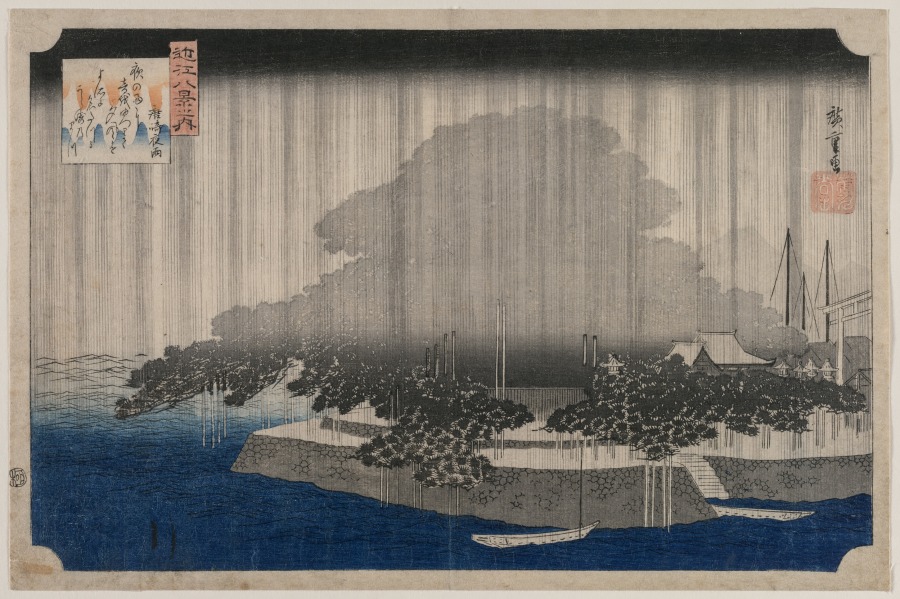
The sacred Karasaki Pine was a famous sight on the shores of Lake Biwa. Its branches, supported by a framework of bamboo poles, sheltered a shrine beneath. The poem on this print reads as follows: Yielding to the sound in the evening rain, and drawing near to the evening wind, he grows famous, the pine tree of Karasaki. —Translation by Matthi Forrer
View the original at Cleveland Museum of Art →Article 2 defines a museum as an institution that collects, keeps and displays materials on history, art, folklore, industry and natural science for public use, carries out research on them, and which has been registered under Chapter 2 of this Act. The registration is not decorative. In law, an unregistered collection open to the public is not a museum.
The cool part. The definition of keeping is given as including raising. That single parenthesis is why a zoo, an aquarium and a botanical garden sit inside museum law in Japan: the collection is allowed to be alive. Article 1 also grounds the statute in the Social Education Act and the Basic Act on Culture and the Arts, which places museums in education first and culture second.
Verify at e-Gov 法令検索 →Use it Take the ratio, not the picture. It sets a page better than a grid does.
Description source: museum curator text — not generated