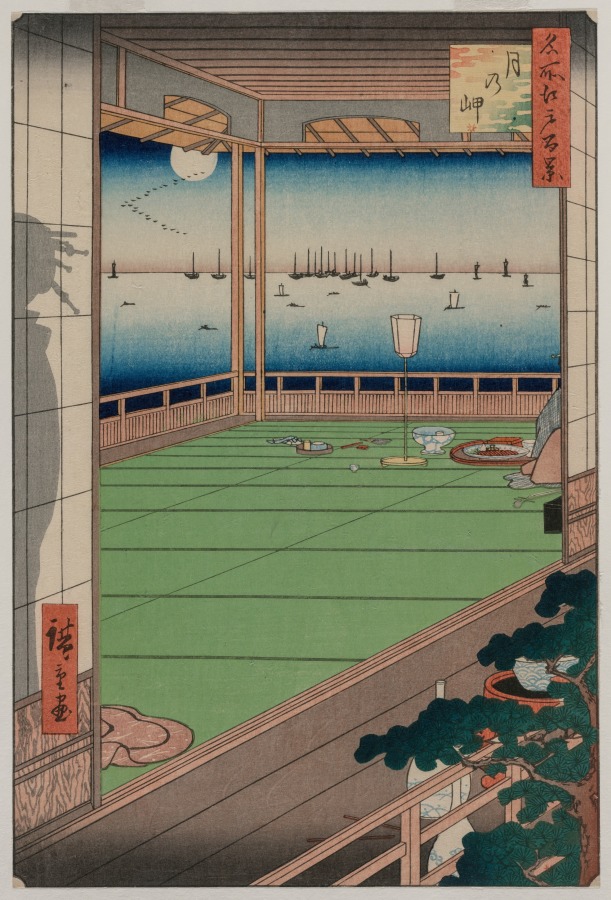
Here, Utagawa Hiroshige’s design places the viewer by pine trees, peering beyond a doorway at the end of a moon-viewing party. The silhouette of a figure with an elaborate hairstyle is visible through a translucent paper door; only the person’s hem trails into view. Another individual remains seated on the floor in the upper right, near a musical instrument and a tray with blue-and-white ceramics, possibly still admiring the autumn moon over ships in Edo (now Tokyo) Bay.
View the original at Cleveland Museum of Art →Article 1 states the purpose plainly: prevent trade in stolen goods, find them quickly, and speed the recovery of victims. Article 2 then defines a used article to include, in the same breath, art objects held for appreciation. Dealing in them requires a licence.
The cool part. Article 16 requires a dealer to record every transaction: the date, the item and quantity, its distinguishing features, and the address, name, occupation and age of the other party. Article 15 requires that a dealer who suspects an item is stolen report it to a police officer immediately. So the antique trade runs on a register the police may read, and a painting becomes a second-hand article the moment it has been used once.
Verify at e-Gov 法令検索 →Use it A motif small enough to blind-deboss, which is where restraint actually shows.
Description source: museum curator text — not generated