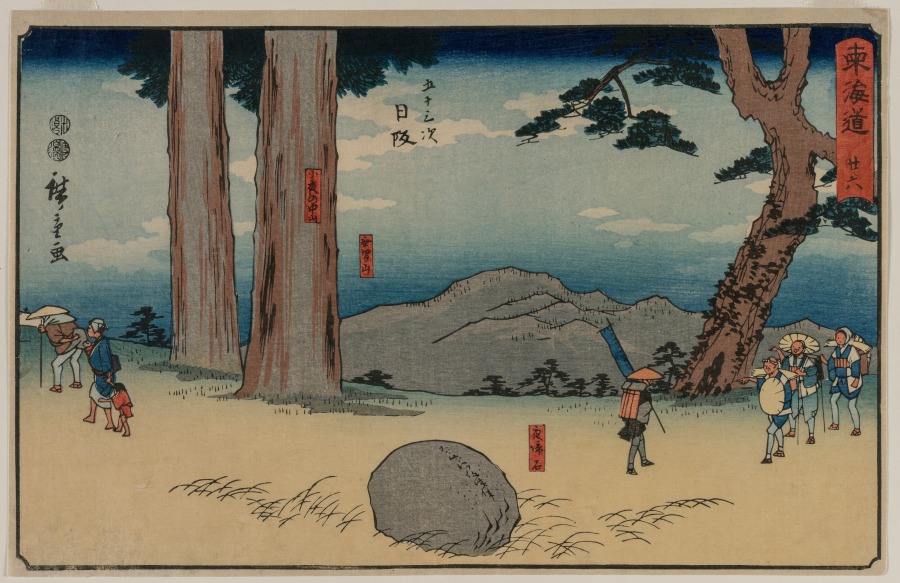
This print is an image of a mountain pass in Nissaka, one of the stops along the Tōkaidō, a road running from Kyoto to Edo (present-day Tokyo). This scene alludes to a legend in which bandits murdered a pregnant woman on that stretch of road, and her blood fell upon a stone. Shown in the foreground, the stone is said to contain the woman’s spirit, and so it weeps each night. In some versions of the story, the stone’s cry alerts a passing monk (really the disguised bodhisattva Kannon) to the presence of her infant, who survived the attack. The monk takes the child from the deceased mother’s body, and raises it as his own. The child goes on to avenge its mother.
View the original at Cleveland Museum of Art →Unusually for a Japanese statute it opens with a preamble, which states that finding joy in creating culture and living among it is an unchanging wish of people, and that culture contributes to world peace. Article 2 then sets the principles: the autonomy of those who make culture must be fully respected, and their creativity, standing and capacity considered.
The cool part. Article 2, paragraph 3 is the line worth reading twice. It says that creating and receiving culture is a right people are born with, and requires an environment in which citizens can appreciate, participate and create regardless of age, disability, economic situation, or the area they live in. Four barriers named in statute, one of which is your postcode. It puts the arts in the same grammatical register as infrastructure. Not a subsidy argued for each year, a standing obligation.
Verify at e-Gov 法令検索 →Use it The border is the idea. Use it as an edge treatment and leave the centre empty.
Description source: museum curator text — not generated