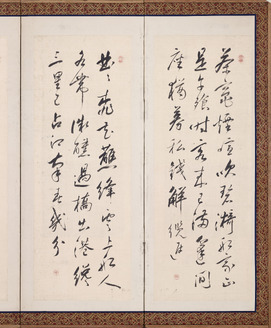
Chūshima Sōkō (1779-1855) was a scholar and literary figure in Kyoto, whose name was Tolutaka. He studied waka poetry and national studies in seclusion, and became proficient in both poetry and prose. The screen painting has an inscription on the sixth panel on the left, which reads "Right, in the boat 'Ryūbō Sōkō' (Tenpō 6), under the name of Lord Daisawa, in the middle of spring (Tenshō 14), 14th year, Chūshima Sōkō composed ten-and-one poems." This suggests that Chūshima Sōkō traveled from his seclusion in Fukimi to Daisawa's residence in Kyoto by boat along the Kamo River, in the second month of Tenpō 14 (1843), and recorded the scenery in seven-line quatrains. Although the painting itself lacks images, its theme resonates with Ito Taiso's (1716-1800) work "Embarking on the Boat.
中島棕隠(一七七九~一八五五)は京都の儒者・文人で、名を徳規という。和歌や国学を伴蒿蹊に学び、詩歌にすぐれ、書にも長けていた。この屏風は、左隻第六扇に「右、自伏水到浪華舟中、作十/一首、書為大澤君、/天保癸卯仲春 棕隠記(印)(印)」とみえる。これにより、天保十四年(一八四三)二月、棕隠が伏見から大坂まで淀川を舟で下るさい、京都の豪商・大沢氏のため、目にした風景を七言絶句に表したものと判明する。絵こそ伴わないが、趣向は伊藤若冲(一七一六~一八〇〇)の『乗興舟』に通じる。
View the original at Japan Search →A weapons statute that contains the most important art registry in the country. Article 2 defines a sword by measurement: a blade of fifteen centimetres or more for a sword, spear or naginata, five and a half for a dagger. Article 14 then carves out an exception. The prefectural board of education registers old firearms of value as art or antiques, and swords of value as art, on the basis of an appraisal by registration examiners appointed for their scholarly knowledge.
The cool part. A Japanese sword is lawful to own because it has been certified as art. Not because it was disarmed, not because it was licensed as a weapon. The judgement is made by the board of education, and Article 14 then requires the board to notify the prefectural public safety commission of what it has decided. The culture side rules, and the police are informed afterwards. Fail the appraisal and the same object becomes contraband.
Verify at e-Gov 法令検索 →Use it The border is the idea. Use it as an edge treatment and leave the centre empty.
Description source: museum curator text, translated — not generated